

Industrial AI · Agentic Systems · OT/IT Convergence · Sasquatch Labs Industrial Series
Walk onto almost any manufacturing floor, water treatment facility, or energy plant in 2026, and you’ll find the same scene that’s existed for the better part of three decades: rows of monitors showing SCADA screens, operators scanning trend lines, and somewhere in a back office, an engineer who knows—because they memorized it, not because the system told them—which tag in the historian corresponds to which pump, on which line, in which building.
That knowledge gap is expensive. It slows down troubleshooting, it walks out the door every time a senior operator retires, and it means the people closest to the equipment are often the least able to ask the data a direct question and get a direct answer. Valak.ai exists to close that gap. It’s a genuinely new category of software, and understanding why it matters means understanding both what came before it and what’s now becoming possible.
What Valak.ai Actually Is
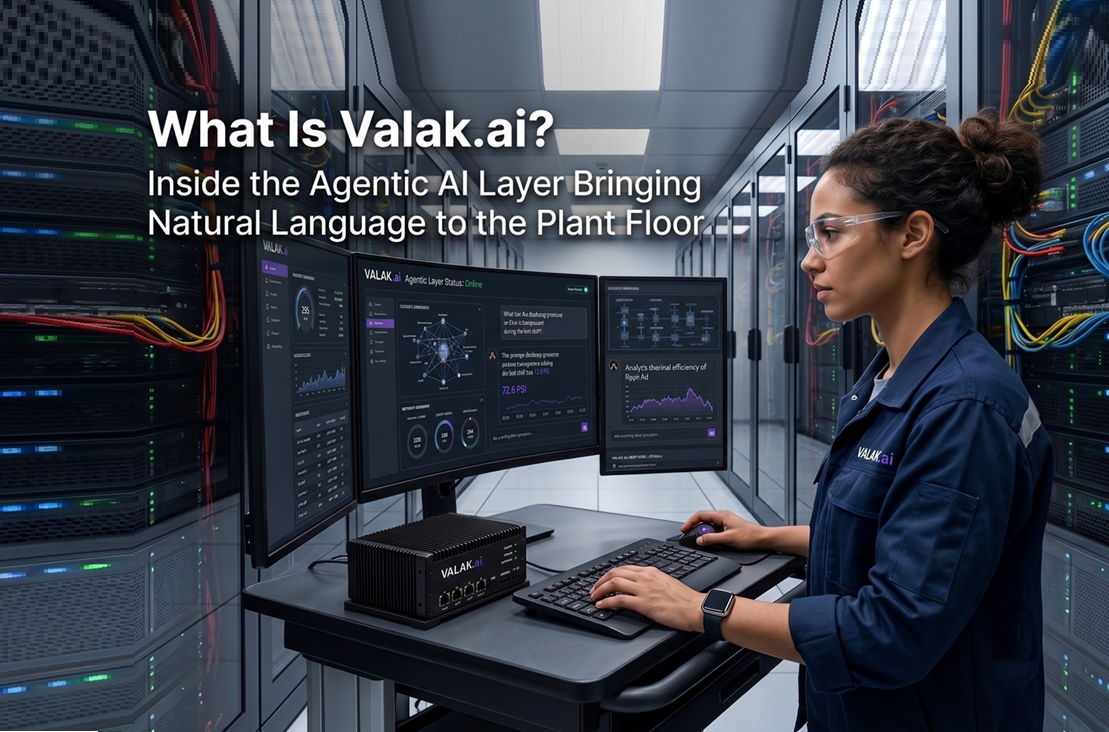
Valak is described by its creators, Sasquatch Labs, as an agentic AI layer for HMI and SCADA systems. Strip away the jargon and the idea is simple: Valak sits on top of the industrial systems you already run—your HMI screens, your SCADA platform, your historian—and lets anyone on your team ask it questions in plain language or by voice, the same way they’d ask a knowledgeable colleague.
Instead of building a new dashboard or forcing your team to learn a new query language, Valak connects directly to the data sources already running your operation: OPC UA servers, AVEVA PI historians, GE Proficy systems, and more. It doesn’t replace any of that infrastructure. It becomes the conversational front end for it.
That distinction matters. A lot of “AI for manufacturing” products ask you to rip out your existing stack or bolt on a separate analytics platform. Valak’s positioning is the opposite: it’s an additive intelligence layer, not a replacement system. You keep the SCADA and historian investments you’ve already made; you simply gain a new way to talk to them.
Valak turns “go pull up the trend for Line 3 compressor discharge pressure over the last shift” from a five-minute manual task into a typed or spoken question that gets answered in seconds, using your own plant’s real data.
The Problem It Was Built to Solve
To appreciate why Valak’s approach is notable, it helps to look at how plant-floor data access has actually evolved. Industry coverage of the space has tracked a consistent pattern over the last several years: HMI and SCADA systems are absorbing more IIoT devices, leaning into hybrid cloud-edge architectures, and slowly preparing for AI capabilities—but the shift from purely on-premises systems has been gradual rather than sudden, especially in industries with strict security requirements or low-latency needs.
In other words, the industry has been adding sensors and data sources faster than it’s been adding ways to actually use that data. The result is familiar to anyone who has spent time on an operations floor:
- Tribal knowledge bottlenecks. The person who knows where a specific tag lives in the historian, or what a particular alarm code actually means in context, is often one specific person—and when they’re out sick or retire, that knowledge goes with them.
- Slow root-cause analysis. Diagnosing a problem often means manually pulling trends across multiple systems, cross-referencing timestamps, and reconstructing a timeline by hand.
- Alarm fatigue. Operators are flooded with alerts but have no fast way to ask “what actually changed in the last hour that might explain this,” so they react to the loudest signal instead of the most relevant one.
- A widening skills gap. New operators are expected to be productive on SCADA systems that took experienced staff years to fully learn.
None of these are new problems. What’s new is that there’s finally a credible technical path to solving them without asking plants to replace systems that, in many cases, are running safety-critical processes and have been validated and trusted for years.
How Valak Works, in Plain English
Think about what happens today when an engineer wants to investigate an issue. They open the historian client, hunt for the right tags, set a time window, maybe export to a spreadsheet, and then interpret the result. Each of those steps is a small skill in itself, and each one is a place where a less experienced team member can get stuck or get it wrong.
Valak compresses that entire workflow into a conversation. Ask it a question—by typing or by speaking—and it does the work that used to require knowing exactly where to look:
- It interprets the question the way a human colleague would, including plant-specific shorthand and equipment names, not just rigid pre-set commands.
- It queries the right source automatically—whether that’s a live OPC UA tag, a historical trend in AVEVA PI, or an alarm log from a Proficy system—without the user needing to know which system holds which piece of data.
- It returns a direct answer, not a dashboard the user then has to interpret themselves.
This is what separates an “agentic” layer from a conventional reporting tool. A standard dashboard shows you data and waits for you to draw conclusions. An agentic system is closer to a capable junior engineer: it can be asked a question it wasn’t explicitly pre-programmed to answer, go find the relevant data on its own, and bring back something useful.
to hours of manual trend-pulling, condensed into a single spoken question
rip-and-replace required—works with the HMI/SCADA/historian you already run
deployment model, built specifically for environments that can’t send data to the cloud
Why “Air-Gapped” and “Lossless” Are the Whole Point
If you’ve spent any time around industrial control systems, two words in Valak’s positioning should jump out immediately: air-gapped and lossless. These aren’t marketing flourishes. They’re the entire reason a product like this is viable in an industrial setting at all.
Most consumer-grade and even many enterprise AI tools work by sending data to a cloud service for processing. In an office productivity context, that’s an acceptable trade-off. In a plant that runs critical infrastructure—a water utility, a chemical processor, an energy facility—it often isn’t even a legal option, let alone an operationally comfortable one. Security teams in this space have repeatedly drawn a clear line: industries with strict security requirements, low-latency needs, or deeply established infrastructure tend to keep their core control functions on-premises rather than migrating them to the cloud, even as cloud adoption accelerates elsewhere in the business.
An air-gapped architecture means Valak can run entirely inside a plant’s own network, with no requirement to phone home to an external server. For an OT (operational technology) environment, that’s not a nice-to-have. It’s frequently the deciding factor in whether a tool is allowed in the building at all.
“Lossless” matters for a different, equally important reason. Many AI systems summarize or compress data before presenting it—which is fine for a marketing report, and dangerous for a process safety decision. If an operator asks about a pressure excursion and the AI has quietly smoothed over a brief spike because it looked like noise, that’s not a convenience. That’s a blind spot with potentially serious consequences. A lossless approach means the underlying data integrity is preserved; the AI is a more efficient way to access the truth, not a filter that decides what the truth was.
The industrial world has watched “AI” promises come and go for years. The products that actually get adopted on real plant floors are the ones that respect two non-negotiables: the data doesn’t leave the building, and the data isn’t quietly altered on the way to the answer. Valak is built around both.
The Bigger Shift: Why Agentic AI Is Coming to Every Plant Floor
Valak isn’t appearing in a vacuum. It’s arriving at a moment when several long-running trends in industrial automation are converging at once.
IIoT and sensor data are exploding
Smart sensors, energy meters, and wireless transmitters are increasingly feeding data directly into HMI and SCADA platforms, fundamentally changing how operations are monitored and optimized—generating volumes of operational data that, in practice, very few humans have the time to manually review.
Hybrid edge-cloud architectures are becoming the norm
Rather than an all-or-nothing move to the cloud, the dominant pattern emerging across the industry is a hybrid one: edge computing handles real-time control and acquisition locally, while cloud services are reserved for historical storage, advanced analytics, and remote monitoring. This hybrid approach lets manufacturers gain the scalability of the cloud without sacrificing the reliability and security required for critical, on-site control functions.
Voice and conversational interfaces are moving from novelty to necessity
Voice-controlled HMIs, once considered an experimental curiosity, are now recognized as one of the more rapidly evolving categories in industrial interface design—part of a broader pattern in which interfaces are expected to anticipate needs and reduce friction rather than simply respond to fixed menus and commands.
Agentic design patterns are reaching operational technology
Across manufacturing more broadly, there’s a recognized shift toward systems that don’t just transmit raw data but contextualize it—annotating information with its origin, timing, quality, and relevance so that both humans and AI agents can act on it meaningfully, rather than treating every data stream as an undifferentiated firehose. Supervisory and orchestration-style AI agents are increasingly being discussed as a way to oversee and optimize plant-wide operations by tying together scheduling, quality, logistics, and maintenance data that has traditionally lived in separate silos.
Put these threads together and a clear picture emerges: the plant floor is generating more data than ever, the architecture for handling that data is maturing into hybrid edge-cloud models, and the interface layer on top of it all is shifting from static screens toward conversational, agentic systems. Valak sits precisely at the intersection of those three trends—which is exactly why “the future of the industry” isn’t hyperbole here so much as a reasonably accurate description of where the puck is already heading.
Who Valak Is Built For
Valak’s design choices point clearly to its intended audience: organizations running real industrial control infrastructure, not startups experimenting with AI as a side project. That includes:
- Manufacturing plants running AVEVA PI, GE Proficy, or OPC UA-based historians who want faster troubleshooting without replacing validated systems.
- Utilities and energy operators for whom air-gapped, on-premises deployment isn’t a preference but frequently a regulatory or security requirement.
- Process industries—chemical, pharmaceutical, water treatment—where lossless data fidelity is a precondition for any tool touching operational decisions.
- Operations and engineering teams looking to reduce the time new hires need to become productive on systems that traditionally took years of tribal knowledge to navigate confidently.
Why This Is the Future, Not Just a Feature
It’s worth being precise about the claim here, because “AI will transform manufacturing” is a sentence that’s been said so often it’s started to lose meaning. The more specific and more defensible claim is this: the interface layer between humans and industrial data is changing, and natural language is winning.
That shift has already happened in other domains. Search interfaces replaced manual indexes. Conversational assistants replaced manually written FAQ lookups. In each case, the underlying data didn’t disappear—the way humans accessed it simply became faster and more natural. Industrial data has been one of the last major holdouts, largely for good reason: the stakes of getting it wrong are higher, the systems involved are older and more heterogeneous, and the security requirements are stricter than almost anywhere else in enterprise software.
What makes this moment different is that the technology has finally caught up to those constraints. It’s now possible to build a conversational AI layer that respects air-gapped deployment, preserves data fidelity, and speaks the native protocols of decades-old industrial systems—rather than asking those systems to change to accommodate the AI. That’s the real breakthrough buried inside Valak’s positioning: not “AI for factories” in the abstract, but AI that was actually designed around the non-negotiable constraints of the environment it’s meant to serve.
As more plants accumulate IIoT sensor data, as hybrid edge-cloud architectures continue to mature, and as the current generation of veteran operators continues to retire and take decades of tribal knowledge with them, the pressure to find a faster, more accessible way to query operational data is only going to intensify. Tools that solve that problem without asking plants to compromise on security or control will have a structural advantage. That’s the bet Valak is built on, and it’s a reasonable one.
Getting Started
If your team is currently running OPC UA, AVEVA PI, or GE Proficy systems and still relies on manual tag-hunting and trend-pulling to answer basic operational questions, that’s precisely the gap Valak is built to close. The value isn’t in replacing what you’ve already built—it’s in finally giving the people who rely on that data every day a faster, more direct way to ask for what they need.
See Valak on Your Own Plant Data
Explore how an air-gapped, lossless agentic AI layer can sit on top of your existing HMI, SCADA, and historian—without replacing a single system you already trust.