

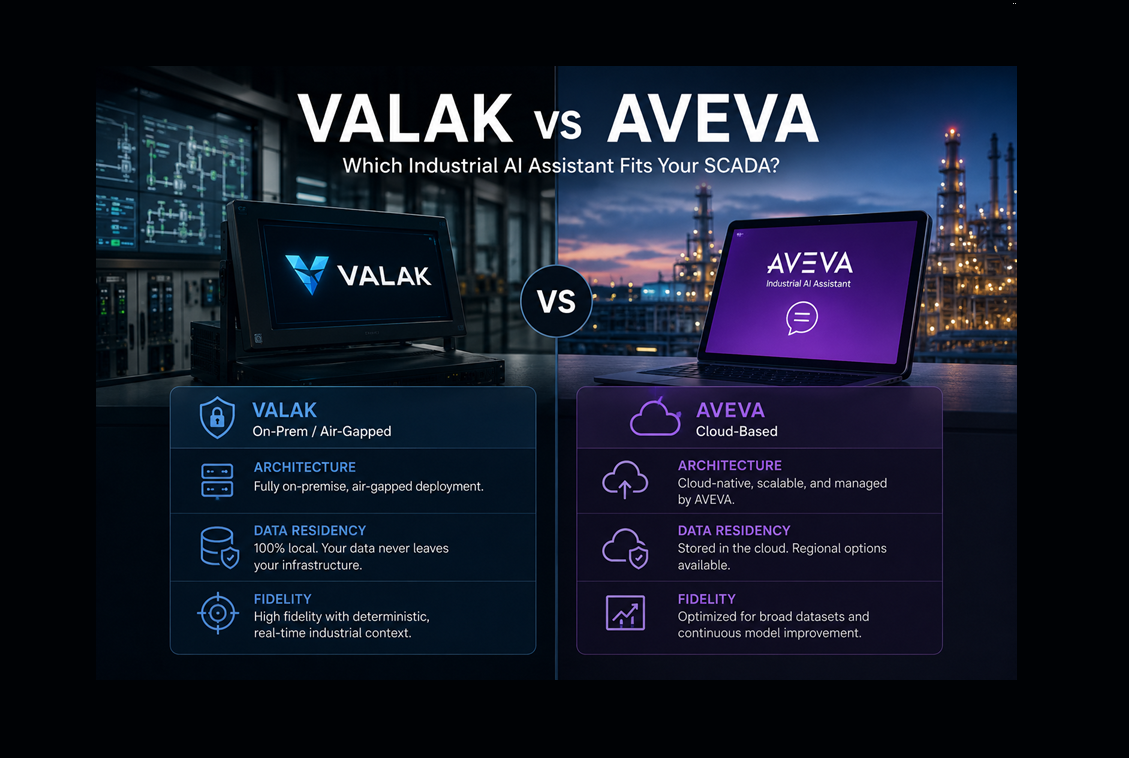
Both promise natural-language access to your operational data. The difference comes down to one question: where does that data have to go to get an answer?
Industrial AI Comparison · HMI/SCADA · AVEVA PI · Sasquatch Labs Industrial Series
If you run AVEVA PI, there’s a good chance you’ve already seen AVEVA’s pitch for its own AI assistant. It’s a reasonable product, built by a company with four decades of credibility in this space, and it’s worth understanding clearly before you decide whether it’s the right fit—or whether a different architecture, like Valak’s, solves your actual constraints better.
This isn’t a takedown. AVEVA’s Industrial AI Assistant is a real, functioning product with thoughtful design choices behind it. But “natural language query for industrial data” is not one single thing—it’s a category with at least two fundamentally different architectures inside it, and which one fits your plant depends almost entirely on questions your security and compliance teams are already asking.
The Quick Answer
AVEVA’s Industrial AI Assistant is delivered through CONNECT, AVEVA’s cloud-based industrial intelligence platform. To use it, your operational data needs to be published to a CONNECT account, where a retrieval-augmented generation pipeline processes natural-language questions against that cloud-hosted data. It’s a capable, well-engineered tool—for organizations comfortable extending their data footprint into AVEVA’s cloud.
Valak takes the opposite architectural starting point. It’s built to run entirely on-premises and air-gapped, sitting directly on top of your existing OPC UA, AVEVA PI, or GE Proficy systems without requiring any data to leave your plant’s network. If cloud dependency is a non-starter for your environment—whether for regulatory, contractual, or plain operational-security reasons—that single architectural decision is usually the deciding factor.
What AVEVA’s Industrial AI Assistant Actually Is
AVEVA’s tool is a generative AI tool used alongside CONNECT data and applications, available to CONNECT visualization users, and it lets users ask industrial-specific questions using natural language through a chat interface. Functionally, it’s impressive: ask it something like “what are the bearing and nacelle temperatures for GE07,” and it determines that GE07 is an asset and that bearing and nacelle temperatures are real-time data points, then assumes a 24-hour window if none is specified before retrieving the relevant data.
Under the hood, it works by using a large language model to determine what data it needs from the CONNECT account, retrieving that data, and generating an answer—a standard retrieval-augmented generation pattern. AVEVA has also built in real safeguards: citations clearly show data sources and values so users can validate results, and guardrails keep questions focused on industrial use cases rather than open-ended internet queries. Access is also permission-aware—it only returns data and results the requesting user has permission to view.
The catch, and it’s an architectural one rather than a quality one, is the foundation underneath all of this: the data has to live in CONNECT. Your Industrial AI Assistant is underpinned by your CONNECT data, so it’s important to consider what data you need to publish to your CONNECT account before the assistant can answer questions about it.
What Valak Is, By Contrast
Valak starts from a different premise entirely: don’t ask the plant’s data to move at all. Instead of publishing operational data to a cloud intelligence platform first, Valak deploys directly inside your existing network and connects natively to the protocols your systems already speak—OPC UA, AVEVA PI, GE Proficy—without requiring a parallel cloud data layer as a prerequisite.
The result is the same kind of conversational, natural-language experience—ask a question by typing or speaking, get a direct answer—but without the upstream step of deciding what operational data you’re comfortable exposing to a third-party cloud platform first.
The Core Difference: Cloud-Dependent vs. Air-Gapped
This is the part worth sitting with, because it’s not a minor configuration detail—it’s the entire architecture of each product.
AVEVA’s own documentation is candid about this trajectory. The company’s broader PI System strategy has been explicit about moving toward cloud-connected operation: newer PI Server releases are described as designed to be cloud-ready, with components like the PI to CONNECT agent enabling customers to transfer on-premises PI System data to AVEVA’s cloud, supporting hybrid architectures that leverage cloud analytics and machine learning. The AI Assistant specifically lives inside that cloud layer, not the on-premises PI Server itself.
To be fair to AVEVA, this isn’t a secret or a bait-and-switch—it’s a deliberate, disclosed strategy. AVEVA has been transitioning toward a subscription-based commercial model under the AVEVA Flex program, designed to offer access to the latest features and seamless integration with AVEVA’s broader cloud portfolio. But it does mean that if you want the AI layer, you’re also adopting the cloud layer underneath it, whether or not your security policy was built with that in mind.
Valak doesn’t ask that question in the first place. The deployment model is air-gapped by default: the AI layer, the connection to your historian or SCADA, and the inference itself all happen inside your own network boundary.
It would be inaccurate to suggest AVEVA is careless with data. The company holds certifications including ISA Secure, ISO 27001, ISO 9001, SOC 2, and ISO 14001, and CONNECT itself is built with enterprise-grade access controls. The distinction here isn’t “secure vs. insecure”—it’s “data leaves the building under strong controls” vs. “data never leaves the building at all.” For some organizations, the first is perfectly acceptable. For others—particularly those bound by regulatory frameworks that restrict offsite data transfer outright—only the second is an option.
Side-by-Side Comparison
| Dimension | Valak | AVEVA AI Assistant |
|---|---|---|
| Deployment model | Air-gapped, on-premises, inside your existing network | Delivered via CONNECT, AVEVA’s cloud intelligence platform |
| Data residency | Data never has to leave your plant network | Operational data must be published to a CONNECT account first |
| Source system support | OPC UA, AVEVA PI, GE Proficy, and other industrial historians/HMI/SCADA | Data sources published into CONNECT, including PI data via the PI-to-CONNECT agent |
| Query method | Natural language and voice query | Natural language chat interface, hybrid semantic search |
| Data fidelity approach | Lossless—underlying data integrity preserved, not summarized away | Retrieves and summarizes data, with citations showing sources used |
| Existing system requirement | Layers onto systems you already run, no platform migration required | Requires CONNECT subscription and data publication workflow |
| Best fit | Regulated, air-gapped, or security-sensitive OT environments | Organizations already standardized on AVEVA’s CONNECT ecosystem |
Summarized Answers vs. Lossless Answers
There’s a second, quieter difference worth understanding: what happens to the data on its way to becoming an answer.
AVEVA’s assistant is explicitly built to quickly find the information you need, summarize it, and send you the resulting answer—a search-and-summarize pattern. That’s a sensible design for engineering documents, saved visualizations, or general operational questions, and AVEVA has paired it with citations so users can trace an answer back to its source.
But summarization is a judgment call, and judgment calls are exactly where a tool can quietly smooth over the detail that mattered most—an unusual but brief pressure spike, a sensor reading that looked like noise but wasn’t. Valak’s lossless approach is built around a different priority: the underlying data integrity is preserved end to end, so the AI is a faster way to retrieve the truth rather than a filter that decides what counts as relevant before you ever see it.
For a question like “find me last week’s maintenance log,” summarization is a feature. For a question that might inform a safety-critical decision, lossless retrieval is the safer default.
When AVEVA’s Approach Makes Sense
- You’re already standardized on CONNECT. If your organization has already committed to AVEVA’s cloud platform for other workflows—engineering data, enterprise-wide dashboards, multi-site aggregation—adding the AI Assistant is a natural extension rather than a new commitment.
- Cloud data residency isn’t a blocker. Some industries and jurisdictions have no specific restriction on operational data leaving the plant network, provided it’s encrypted and access-controlled.
- You want unified engineering and operational data in one place. AVEVA’s assistant is designed to unify engineering and operational data, reducing time spent navigating multiple applications—a genuinely useful capability if your workflows span both domains.
- You’re comfortable with a subscription-based, cloud-first roadmap. AVEVA’s direction is clear and disclosed; if that direction matches where your organization is already heading, fighting it offers little upside.
When Valak Makes Sense
- Air-gapped is a hard requirement, not a preference. Utilities, defense-adjacent facilities, and certain regulated process industries often can’t send operational data offsite under any circumstances, no matter how strong the encryption.
- You want to keep your existing system investments untouched. Valak doesn’t ask you to restructure your data architecture around a new cloud platform before the AI layer can function.
- Lossless fidelity matters more than summarized convenience. If the cost of a smoothed-over data point is measured in safety incidents rather than inconvenience, lossless retrieval is the more defensible default.
- You’re running a mixed environment. Plants using a combination of OPC UA, AVEVA PI, and GE Proficy systems—rather than a single AVEVA-only stack—benefit from a layer designed for multi-source compatibility from the ground up.
The Bottom Line
AVEVA’s Industrial AI Assistant is a legitimate, well-built product from a company with deep credibility in industrial software, and for organizations already operating inside the CONNECT ecosystem, it’s a sensible choice. But it is, by design, a cloud-first tool—your data has to be published to CONNECT before the assistant can answer a single question about it.
Valak exists for the plants where that’s not an option. If air-gapped deployment, lossless data fidelity, and zero dependency on a third-party cloud platform are requirements rather than nice-to-haves, the architecture underneath the product matters more than any individual feature comparison. That’s the gap Valak was built to close.
Frequently Asked Questions: Valak vs. AVEVA AI Assistant
1. Does AVEVA’s Industrial AI Assistant require the cloud to work?
Yes. The Industrial AI Assistant is delivered through CONNECT, AVEVA’s cloud-based industrial intelligence platform, and is available to CONNECT visualization users. Operational data must be published to a CONNECT account before the assistant can answer questions about it. Valak, by contrast, runs fully on-premises and air-gapped, with no cloud publishing step required.
2. Can Valak work with AVEVA PI data?
Yes. Valak connects natively to AVEVA PI historians, along with OPC UA and GE Proficy systems, without requiring that data first be transferred into a separate cloud platform.
3. Is AVEVA’s AI Assistant free or a paid add-on?
CONNECT platform services, including the Industrial AI Assistant, are included as part of an AVEVA Operations Control subscription at no additional charge. However, all CONNECT services are funded through AVEVA’s Flex credit subscription program, so access depends on an organization’s existing Flex commitment rather than being a standalone free tool.
4. Is AVEVA’s Industrial AI Assistant a finished product or still in development?
As of this writing, AVEVA’s Industrial AI Assistant configuration is documented as an open beta preview, meaning it is still being actively refined. Organizations evaluating it should confirm current release status directly with AVEVA, since beta features can change.
5. Does AVEVA’s AI Assistant summarize data or return raw values?
It primarily summarizes. The assistant is designed to quickly find information and summarize it before sending a resulting answer, with citations showing which sources were used. Valak takes a lossless approach instead, preserving underlying data integrity rather than summarizing it away, which matters more for safety-critical decisions.
6. Which is more secure, Valak or AVEVA’s AI Assistant?
Both take security seriously, but through different models. AVEVA holds certifications including ISA Secure, ISO 27001, ISO 9001, SOC 2, and ISO 14001, and never blends customer data across accounts to train its models. Valak’s approach is architectural rather than policy-based: data never leaves the plant network in the first place, which is the deciding factor for organizations where offsite data transfer isn’t permitted under any controls.
7. Does AVEVA’s AI Assistant fall under the EU AI Act’s high-risk category?
No. AVEVA states its AI products do not fall under the EU AI Act’s “High Risk” or “Prohibited” classifications, since its solutions are designed to support customers analyzing their own industrial data rather than making autonomous high-stakes decisions.
8. Can I use AVEVA’s AI Assistant without adopting CONNECT?
No. Some AVEVA AI solutions are built directly within an application, but the Industrial AI Assistant specifically requires CONNECT to function. There is currently no on-premises-only path to using it.
9. What kind of questions can each assistant answer?
Both support natural-language questions about assets, tags, and operational data, such as asking for a temperature reading on a specific piece of equipment. AVEVA’s assistant additionally searches engineering documents and saved visualizations within CONNECT. Valak focuses specifically on direct, lossless query access to HMI, SCADA, and historian data without requiring a parallel document-search layer.
10. Which one should a plant choose if data residency rules are strict?
If regulatory or contractual requirements prohibit operational data from leaving the plant network under any circumstances, Valak’s air-gapped architecture is the more direct fit, since it was built around that exact constraint rather than offering cloud security as a mitigation.
See Valak Running Air-Gapped, On Your Own Data
No cloud publishing step. No platform migration. Just a natural-language layer on top of the OPC UA, AVEVA PI, or GE Proficy systems you already run.