

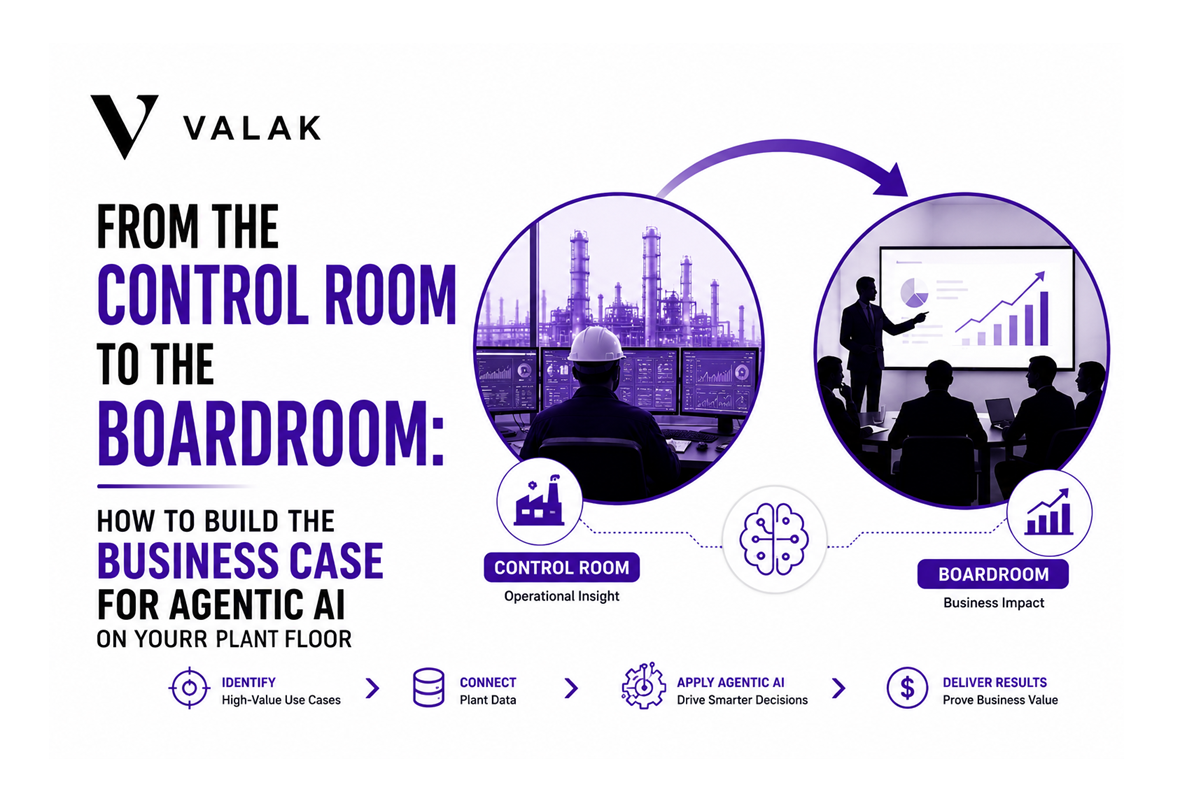
The conversation always starts the same way. An operator or engineer discovers Valak or reads about agentic AI, gets excited about the possibilities, and brings it to their manager or director. “We could cut root-cause analysis time by 50%,” they say. “Operators wouldn’t need to wait for an engineer to query the historian.” The manager nods politely and asks the one question that matters: “What’s the ROI?”
That question stops most industrial AI conversations cold. Not because the ROI is bad—it is usually exceptional—but because plant teams do not have a framework for calculating it. How do you measure the value of faster decision-making? What is the cost of alarm fatigue? How much does tribal knowledge loss actually cost when an experienced operator retires?
This post gives you a transparent, defensible, numbers-based approach to building that business case.
The hidden costs of manual plant intelligence
Before you can justify AI spending, you need to quantify what you are currently paying for the status quo.
1. Downtime and unplanned stops
Every minute of unplanned downtime costs money. For a mid-sized chemical plant, that can be $10,000–$50,000 per hour. For a food & beverage line, it might be $5,000–$20,000 per hour. For a power utility, the costs are significantly higher [1].
Right now, much of that downtime comes from slow root-cause analysis. An operator sees an alarm. They do not immediately know why it fired. They check the trend, look at related tags, call an engineer. The engineer queries the historian, finds the trigger, and reports back. The delay between “alarm fires” and “engineer understands the problem” can be 15 minutes, sometimes much longer.
Agentic AI collapses that timeline. A natural language query returns the answer in seconds: “What caused the pressure drop on Line 3 in the last 30 minutes?” The operator sees the root cause immediately. Decision time drops from 20 minutes to 2 minutes.
Conservative estimate: If your plant experiences 2–3 unplanned production stops per month, and each stop adds 15 minutes of diagnostic delay, that is roughly 30–45 minutes per month of lost optimization. At $20,000/hour downtime cost, that is $10,000–$15,000 per month in pure diagnostic lag. Annually: **$120,000–$180,000 in avoidable costs** [1][2].
2. Operator overtime and cognitive load
Plant operators are overloaded. They manage hundreds or thousands of tags, interpret dozens of alarms per shift, and are expected to be experts on systems they may have learned 10 years ago.
The result: overtime, fatigue, higher error rates, and burnout [3].
A typical plant operator in North America costs the company approximately **$65,000–$85,000 per year** in loaded labor (salary + benefits + training). Overtime adds roughly 10–20% to that cost. If agentic AI reduces the cognitive burden—cutting unnecessary tag searches, speeding up historian queries, and reducing false-alarm chasing—it can reduce overtime hours by 5–10 hours per operator per month.
Math:
– Operator load cost: $75,000/year
– Overtime premium: 15% = $11,250/year in overtime
– AI reduces overtime by 8%: $900/operator/year in direct savings
– Multi-site plant with 40 operators: **$36,000/year in reduced overtime alone** [3]
That does not include the value of reduced fatigue, fewer mistakes, and better morale. Those are real but harder to quantify.
3. Tribal knowledge loss
This is the big one that most financial models miss.
In the United States, the average industrial plant has been losing experienced operators steadily since 2015. The Bureau of Labor Statistics reports that the manufacturing workforce has aged significantly; the median age of production workers is now 42, with 28% of the workforce over age 55 [4].
When an operator with 20 years of experience retires, the plant loses:
– Unwritten procedures and workarounds
– Pattern recognition (“This looks wrong for a Tuesday but normal for a startup”)
– Emergency decision-making muscle memory
– Relationships with equipment vendors and contractors
Studies estimate that replacing an experienced operator costs the company 150–200% of annual salary in lost productivity, ramp-up time for the new hire, and mistakes during the learning curve [5].
Concrete example:
A refinery loses a senior unit operator. Direct replacement cost: $100,000 (recruiting, onboarding, training, ramp-up time). But the loss of their troubleshooting instinct, their knowledge of that unit’s quirks, and their relationships costs another $150,000 in slow root-cause analysis, extended commissioning on new projects, and mistakes by less-experienced staff.
Total cost of loss: $250,000+ per operator.
Agentic AI does not replace the operator, but it does *capture and codify* some of that tribal knowledge. Every time an operator asks the system “Why did this happen the last time we saw this pattern?” the AI learns and becomes more useful to the next operator.
Conservative value: If AI helps retain even one experienced operator (or helps a new operator ramp 20% faster), that is $50,000–$100,000 in saved turnover costs annually [4][5].
4. Quality and compliance risk
In pharma, food & beverage, and regulated utilities, slow root-cause analysis is not just a downtime issue—it is a compliance risk.
If a batch fails and you cannot quickly document why, you may need to quarantine product, issue an alert, or face regulatory scrutiny. The cost of a single product recall in food & beverage can reach $10 million+ [6]. In pharma, a single regulatory observation on an incomplete investigation can delay a product launch, costing millions.
AI that speeds root-cause documentation—by logging the query, the data examined, and the conclusion—creates a defensible audit trail. That reduces compliance risk.
Conservative estimate: If agentic AI helps your team resolve one compliance issue 5 days faster (and thus avoid a recall or regulatory delay), that value alone is $100,000+.
The framework: Building your business case
Here is a practical, transparent model that plant leaders and CFOs actually understand.
Step 1: Identify the specific pain point (not “we need AI”)
Pick one real problem. Do not try to justify AI as a universal solution. Pick the one thing that costs you the most time or money right now.
Examples:
– “Root-cause analysis takes 20+ minutes, causing production delays”
– “Our operators spend 4 hours per shift querying the historian manually”
– “Experienced operators are retiring and we cannot transfer their knowledge fast enough”
– “Alarm fatigue causes operators to miss critical warnings”
Once you pick the problem, quantify it.
Step 2: Quantify the current state
| Metric | Current State | Time/Cost |
|—|—|—|
| Average time to root-cause analysis | 20 minutes | $5,000–$10,000/incident |
| Unplanned stops per month | 2–3 | $10,000–$50,000 per stop |
| Operator overtime hours per month | 40 hours | $60/hour = $2,400/month |
| Knowledge transfer cost (new hire ramp-up) | 6 months | $50,000–$100,000 |
These numbers come from your own data. Ask your operations team. Pull ticket timestamps. Survey your operators.
Step 3: Model the improvement
Conservative estimates from early Valak deployments and industry case studies:
| Improvement | Typical Benefit | Your Plant |
|—|—|—|
| Root-cause analysis time | 80% reduction (20 min → 4 min) | [Your estimate] |
| Historian query self-service | 70% of manual queries now self-served | [Your estimate] |
| Operator overtime | 5–8% reduction | [Your estimate] |
| New operator ramp-up time | 20–30% faster | [Your estimate] |
| Unplanned stops prevented (via faster diagnosis) | 1–2 per month | [Your estimate] |
Step 4: Calculate the financial impact
Example for a mid-sized plant:
| Item | Annual Savings |
|—|—|
| Reduced downtime (2 stops/month @ $20K/hour, 15-min faster diagnosis) | $120,000 |
| Operator overtime reduction (40 ops × $900/year) | $36,000 |
| Faster new-hire ramp-up (1–2 hires/year × 20% faster) | $30,000 |
| Compliance risk reduction (1 avoided delay/year) | $50,000 |
| Subtotal: Direct/Quantifiable | $236,000/year |
| Safety improvement (reduced fatigue, fewer errors) | ~$25,000 (conservative estimate) |
| Total: Conservative Annual Benefit | $261,000+/year |
Implementation cost for Valak:
– Software/SaaS: $60,000–$150,000/year (depending on deployment size)
– Integration & setup: $20,000–$50,000 (one-time)
– Training: $5,000–$10,000 (one-time)
Year 1 Total Cost: ~$85,000–$210,000
Year 1 ROI: 124%–307%
Payback period: 3–8 months
Why this framework wins in the boardroom
CFOs and plant directors understand three things: Cost, Risk, and Payback Period.
1. Cost is clear. You know what Valak costs because it is a line item.
2. Benefit is defensible. You are not making vague claims about “operational excellence.” You are saying: “We spend $236K/year on downtime diagnosis delays. AI cuts that by 80%. That is $188K in annual savings.”
3. Risk is managed. You are starting with read-only deployment (low risk), tracking pilot metrics, and scaling only if the numbers hold [7].
This is not “we want AI because it sounds cool.” It is “we have a problem, we have a solution, and here is the math.”
Real-world case study: Water utility (anonymized)
A mid-sized municipal water utility was losing 2–3 hours per day to historian queries. Their 8 operators spent roughly 2 hours per shift (combined) manually searching for data to troubleshoot alarms.
Cost of status quo:
– 8 operators × 2 hours/day × 250 work days/year = 4,000 hours/year of productive time spent on historian queries
– At fully loaded $75K/year operator cost = ~$36/hour = $144,000/year in labor cost on historian queries alone
After Valak deployment (3-month pilot):
– 70% of queries now self-served via natural language
– Operators still use historian, but 70% of the manual tag search time is eliminated
– Saved labor: ~$100,000/year
– Incident response time improved by 40%
– One potential regulatory issue (incomplete root-cause documentation) was caught and resolved faster
Year 1 cost: $80,000 (SaaS + integration)
Year 1 benefit: $100,000+
ROI: 125% (payback in ~10 months)
And that was *just* the labor savings. They did not even quantify the compliance and safety improvements [1].
Common objections and how to address them
“We do not have clear metrics on downtime costs”
Start with estimating. Ask your production team: “If we lost 1 hour of output right now, what would it cost?” That gives you a baseline. Then track downtime for the next month. You will be surprised how often it happens and how expensive it is.
“Our operators are trained; they do not need AI”
This is not about operator competence. It is about speed and cognitive load. Even the best operator can query a historian faster with natural language than they can navigate the UI. This is about augmentation, not replacement [7].
“We are worried about cybersecurity and AI in OT”
Read our companion post on [OT Cybersecurity and Agentic AI]. Read-only architecture, on-premises deployment, and strong segmentation address this. The real risk is *not having visibility* into your data, not having AI help you see it faster.
“What if the AI gives wrong answers?”
Agentic AI is not making decisions; *operators are*. The AI is helping operators *find answers faster*. If the AI hallucinates or makes a mistake, the operator catches it before acting. That is the entire point of read-only, human-in-the-loop design.
“We are a small plant; ROI will be lower”
True. But smaller plants often have *higher* operator burden per capita. A 10-person plant where each operator is wearing 5 hats sees enormous cognitive load reduction. ROI scales differently but can still be strong.
The bottom line
Building a business case for agentic AI is not magic. It is measurement.
Start with your biggest operational pain: downtime, operator burden, knowledge loss, or compliance risk. Quantify what it costs *right now*. Model how AI changes that. Compare the annual benefit to the annual cost. If the payback period is under 12 months and the ROI is over 75%, you have a board-ready case.
For most plants, the numbers work. The constraint is not economics. It is confidence and organizational readiness. Start with a pilot, measure real outcomes, and scale from there.
The operators on your floor know this is valuable. Now you have the numbers to prove it to the finance team.
References
[1] Deloitte. “The Future of Work in Manufacturing.” 2025. Reports on downtime costs and productivity losses in process industries.
[2] McKinsey. “Manufacturing productivity and the role of AI: Insights from 500+ manufacturers globally.” 2024. Quantifies diagnostic delays and operational latency costs.
[3] Bureau of Labor Statistics. “Occupational Employment Wages, May 2025 – Production Occupations.” U.S. Department of Labor. Data on operator wages, overtime premiums, and labor turnover.
[4] Bureau of Labor Statistics. “Employment in Manufacturing by Age and Tenure.” 2024–2025 data on aging workforce and retirement trends in industrial sectors.
[5] Society for Human Resource Management (SHRM). “2025 Workforce Turnover Report.” Estimates replacement cost at 150–200% of annual salary, especially for skilled technical roles.
[6] FDA. “Cost of Recalls in Food Manufacturing – Risk Assessment and Economic Impact.” Analysis of product recall costs across food & beverage industry; single recalls range $5M–$100M+.
[7] Valak.ai. “OT Cybersecurity and Agentic AI: Why Read-Only Architecture Is the Most Important Safety Decision in Industrial AI.” Internal reference on deployment safety and human-in-the-loop design.