

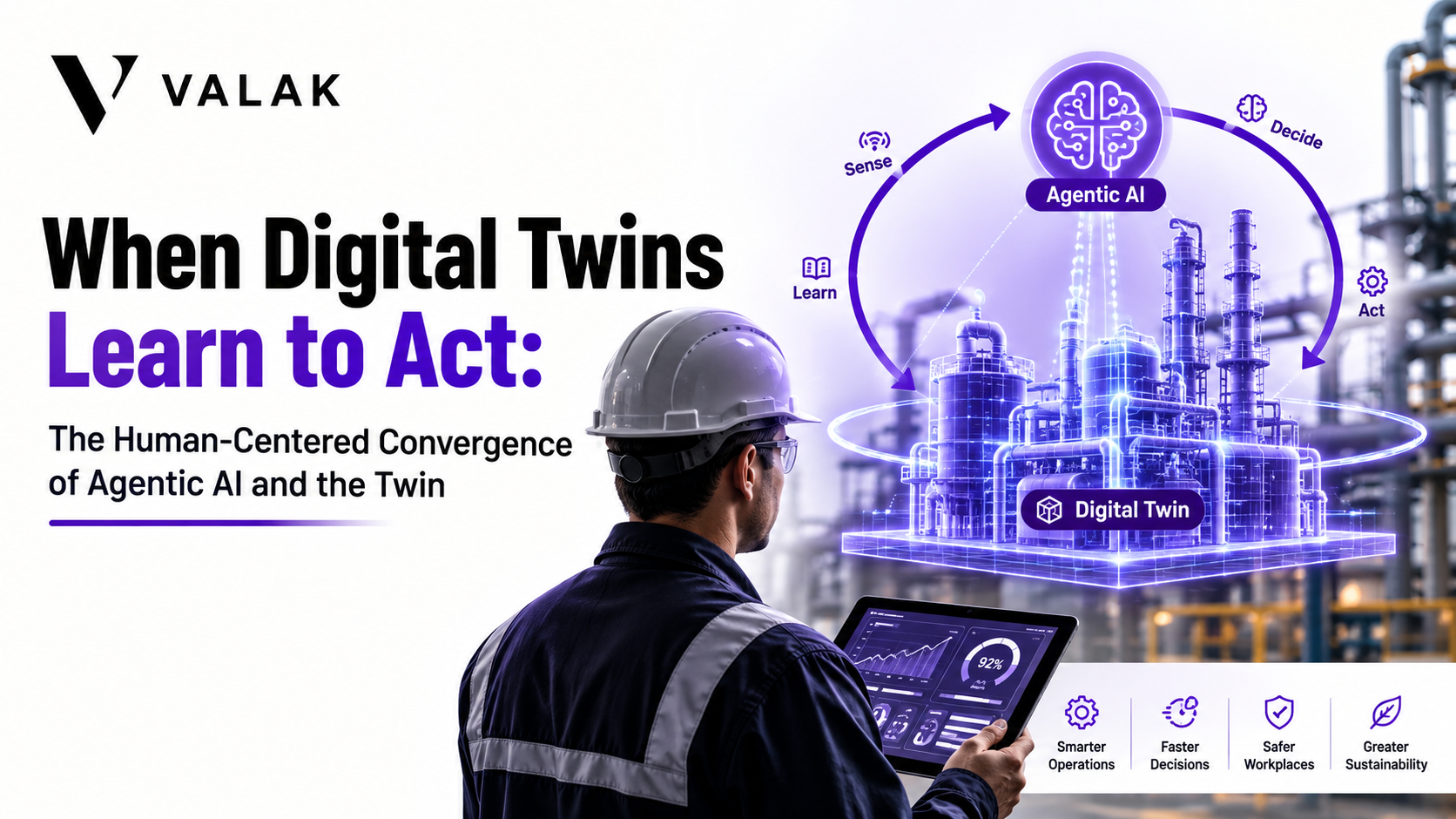
Digital twins have matured from static replicas into rich, operational models. Agentic AI—systems that perceive, reason, plan, and act within guardrails—promises to turn those models into living copilots for frontline teams. This article explains why the convergence of digital twins and agentic AI matters, how to evaluate real value (not vendor hype), and how to build a practical, human-centered rollout that preserves safety, auditability, and operator expertise.
Why this convergence matters now
Three industry forces are making the convergence inevitable: (1) Operators and engineers demand faster, contextualized answers from years of historical and real-time data; (2) IT–OT semantic convergence is finally delivering the data fabrics digital twins need to be accurate and persistent; and (3) regulatory, safety, and risk frameworks increasingly insist on traceability and human accountability when AI influences operations. Put simply: we are past proof-of-concept. The question is not whether to adopt, but how to adopt responsibly.
Definitions that keep conversations honest
Before we proceed, a quick glossary so procurement, OT, and operations speak the same language:
- Digital Twin:A contextualized digital replica of physical assets, processes, and relationships, designed for simulation, diagnostics, and historical analysis.
- Agentic AI:Autonomous software entities that can sense, reason, plan, and execute tasks within explicit constraints and with observable decision trails.
- Software-defined Operations:An architecture where the control plane for physical systems is managed like software—configurable, observable, and versioned—enabling repeatable agentic workflows.
- Human-in-the-loop (HITL):Design pattern that ensures humans retain authority over critical decisions, with AI providing evidence and recommended actions, not blind automation.
What a twin + agentic AI stack looks like in practice
At the center is the digital twin: a time-aware model built from historians, MES/MOM, asset registry, maintenance history, and contextual data such as weather or feedstock quality. Around it sit three functional layers that together enable safe agentic behavior:
- Perception & Data Fabric:Ingest and harmonize telemetry, events, documents, and unstructured notes. This layer normalizes semantics (units, tag names), estimates confidence, and flags data gaps.
- Causal Model & Simulation:The twin is not just a mirror; it contains causal relationships, parameterized models, and scenario engines that allow the agent to hypothesize root causes and test interventions virtually before recommending them.
- Agentic Orchestration & Guardrails:Where the agent reasons, plans, and proposes actions. Guardrails enforce read-only vs. write permissions, require approvals for control changes, log every inference, and surface provenance for auditors and operators.
A human-centered use case: diagnosing a cascade upset
Imagine a refinery unit where a compressor surge propagates into downstream heating, causing transient alarms across three units. Traditionally, operators chase each alarm, pull trends, and call specialists. With a twin + agentic AI stack:
- Perception detects correlated spikes and reconstructs a synchronized timeline across all historians, compensating for timestamp drift and sampling disparities.
- The agent runs scenario simulations in the twin: is it sensor drift, compressor surge, or a setpoint interaction? Each hypothesis is scored with confidence and impact estimates.
- The system proposes 3 ranked actions (monitor, bleed compressor to safe margin, notify rotating equipment team) with expected recovery time and risk delta for each. The operator reviews, accepts a read-only recommended monitoring plan, and approves a maintenance ticket for investigation.
Notice what did not happen: the agent did not change a field setpoint without human approval. It did not replace judgment. It amplified it—turning hours of data wrangling into a concise, auditable decision package.
Quantifying value — practical ROI levers
The twin + agentic AI convergence unlocks measurable levers for CFOs and plant managers. Here are the most reliable ones to model and measure in a pilot.
- Faster root-cause analysis:Reduce mean time to diagnosis by 60–85% by surfacing causal chains and historical analogs.
- Reduced false trips and unnecessary interventions:Avoid field responses for correlated false alarms through higher-confidence triage.
- Shorter ramp-up for new hires:Capture tribal knowledge in searchable narratives and decision trails; new operators reach competence faster.
- Safer simulation of interventions:Test changes in the twin before proposing real-world adjustments; reduces risk and accelerates approvals.
- Predictive interventions:Identify leading indicators and auto-schedule maintenance windows that minimize lost production.
These levers can be translated into conservative, auditable metrics for a pilot: minutes saved per incident, reduction in maintenance truck rolls, percent of historian queries handled without engineering support, and near-miss detections avoided.
Implementation principles to minimize risk and maximize adoption
Too many failures occur because organizations treat agentic AI like another SaaS checkbox. Instead, follow these human-centered principles.
- Start with read-only + HITL:Let operators see recommendations and evidence, not invisible actions. This builds trust and preserves safety.
- Invest in semantic data foundations:Spend the time to map tag ontologies, units, and context. A reliable twin depends on reliable semantics.
- Build explainability and provenance:Log every inference, model input, and simulated scenario. Operators and auditors must be able to trace why the agent suggested an action.
- Design for incremental automation:Move from insight → recommended action → assisted execution → controlled automation in stages only after demonstrated safety and ROI.
- Prioritize operator workflows:Embed agent outputs where operators already work (HMI, mobile, maintenance systems) to remove friction and shadow-IT.
- Define metrics and guardrails up front:Agree on KPIs for the pilot—MTTD, MTTR, false-alarm rate, operator satisfaction—and stop conditions.
Organizational change: the most important twin to build
Technology is straightforward compared with change management. Successful programs treat the twin as an organizational asset, not a project. That means investing in: a) operator training that emphasizes agent interrogation skills (how to ask a twin the right question), b) cross-functional governance (OT, IT, safety, compliance), and c) a knowledge lifecycle process to capture and refine decision narratives the agent produces.
A short pilot blueprint
Run a 90-day, low-risk pilot using this blueprint:
- Scope:One unit or line with measurable incident history (e.g., compressor station, packaging line, water treatment clarifier).
- Data:Historian + MES + maintenance logs + two external context feeds (weather, energy price).
- Goals:Reduce diagnosis time by X%, reduce false trips by Y, capture Z decision narratives for knowledge transfer.
- Safety:Read-only operation, approvals required for control changes, and explicit rollback procedures.
- Metrics:Track MTTD, MTTR, historian query volume, operator satisfaction, and near-miss counts.
Ethical, regulatory, and audit considerations
Regulators and auditors will view agentic actions through the lens of responsibility and traceability. Make sure your implementation includes:
- Immutable logs of every recommendation and the inputs that produced it.Versioned model artifacts tied to time-bound deployments.Human approval records for any control action.Data residency and access controls aligned with corporate and regional policies.
Common pitfalls and how to avoid them
- Over-automation too early:Resist the urge to let agents act without approvals until the twin demonstrates robust simulation accuracy and low false-positive rates.
- Skipping semantic cleanup:Without consistent tag semantics and unit normalization, the twin will be brittle and the agent will produce misleading inferences.
- Ignoring operator workflows:If the agent’s outputs are not integrated into the operator’s existing tools, adoption will stall.
- Treating the twin as one-off:Twinning is a lifecycle; plan for continuous model updates, revalidation, and experiential learning from operators.
The horizon: augmenting judgment, not replacing it
The real promise of a twin + agentic AI paradigm is not full autonomy. It is a new kind of collaboration where AI reliably surfaces context-rich hypotheses and operators apply judgment with unprecedented speed. The path forward is iterative: simulation-validated suggestions, human approvals, and gradual increases in automation only where the twin has proven fidelity and the organization has mature governance.
References and further reading
Selected sources and industry signals that informed this article:
- Manufacturing Predicts 2026: AI Agents, Digital Twins and the Race to Autonomous Operations.
- Hannover Messe 2026 insights: Industrial DataOps and the shift from insight to execution.
- Infosys engineering blog. IT–OT Convergence, Agentic AI & the Autonomous Factory.
- IoT Analytics, C3 AI, and industry reports on predictive maintenance ROI and manufacturing AI adoption (2023–2026).
- IDC, ARC Advisory Group, and Deloitte industry outlooks on IT–OT convergence and digital-twin adoption.