

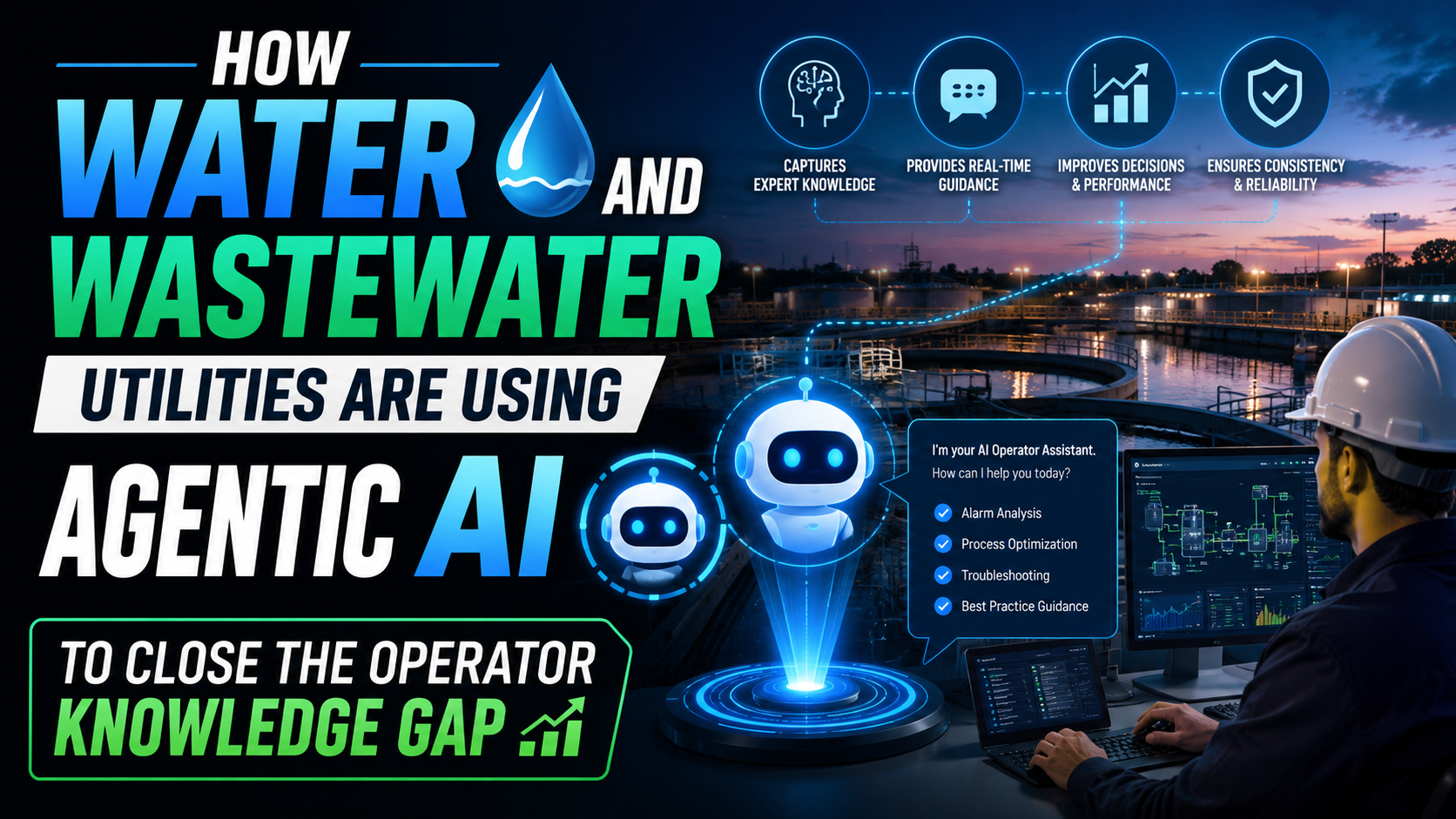
Water utilities are facing a perfect storm: half their operators are nearing retirement, cybersecurity regulators are demanding air-gapped architectures, and the new operators coming in have no practical way to access the institutional knowledge embedded in decades of SCADA and historian data. Agentic AI is emerging as the operational continuity tool this sector has been waiting for — and in 2026, the deployment picture is becoming clearer.
Water Utilities · Wastewater Treatment · Agentic AI · SCADA · OT Cybersecurity · Operator Knowledge Gap · Sasquatch Labs Industrial Series · July 2026
- The Silver Tsunami hitting water utilities harder than anywhere else
- What walks out the door when a water operator retires
- The cybersecurity layer: why water utilities cannot use cloud AI
- The regulatory pressure: EPA, CISA, and New York’s 2026 rules
- How AI adoption is actually progressing in water utilities
- What agentic AI specifically does for water utility operators
- Five practical use cases in water and wastewater operations
- Why air-gapped agentic AI is the only viable architecture for most utilities
- How Valak fits into the water utility picture
- Frequently asked questions
The Silver Tsunami Hitting Water Utilities Harder Than Anywhere Else
Every industrial sector is dealing with workforce retirement. But the water and wastewater sector is dealing with it at a scale, a pace, and with a set of consequences that makes it qualitatively different from the same problem in automotive manufacturing or oil and gas.
The numbers are stark. Approximately half of all water and wastewater plant operators are aged 45 or older, and many will retire within the next decade. When experienced operators leave, they take decades of institutional knowledge with them that is critical to maintaining treatment processes, responding to emergencies, and ensuring regulatory compliance. This knowledge gap poses real risks to water quality and system reliability.
The New England Water Environment Association estimates that up to 20 percent of water utility workers may retire or transition out of their roles each year through at least 2026, accelerating the loss of experienced operators and institutional knowledge. That is not a gradual transition — it is an accelerating outflow of experienced personnel that exceeds the sector’s capacity to replace and train at equivalent rates.
of all water and wastewater plant operators are aged 45 or older, per Water Finance and Management 2026
of the US water workforce will be eligible for retirement within the next 10 years, per EPA estimates
of water utility workers may retire or leave per year through at least 2026, per NEWEA
median age of water sector employees — six years above the national median across all occupations
The EPA estimates that approximately 33% of the water workforce will retire in the next 10 years. The median age of water sector employees is 48 — six years above the national median employee age. Estimates place the loss of current utility employees at 30 to 50 percent within the next ten years.
The American Water Works Association’s 2025 State of the Water Industry report identified the aging workforce as one of the most critical issues moving up the sector’s priority list — not because it is new, but because the timeline has compressed. The “Silver Tsunami” that utilities have been discussing for a decade is no longer a future threat. It is arriving now, at most utilities simultaneously, with no adequate pipeline of experienced replacement operators in most service areas.
What Walks Out the Door When a Water Operator Retires
To understand why this workforce transition is an operational continuity crisis rather than just a hiring challenge, you need to understand what water utility operators actually carry in their heads after twenty or thirty years on the job — and why it cannot be captured in a training manual or an SOPs binder.
A water treatment plant is a complex biological, chemical, and mechanical system that behaves differently across seasons, source water quality variations, demand fluctuations, equipment ages, and a thousand other variables that experienced operators have learned to read and respond to through years of direct observation. The SCADA system records the numbers. The experienced operator knows what those numbers mean in context — which combination of readings is normal for a Tuesday in August after the reservoir has been running low, and which combination means something is wrong even though no alarm has fired.
That contextual knowledge is embedded in the historian data — the record of what happened, when, under what conditions, and what followed. But accessing it requires knowing where to look. The institutional knowledge of a twenty-year water utility operator is not just the knowledge of how the plant works. It is the knowledge of how to find the relevant data in a system that may have been configured by three different engineers over fifteen years, with tag naming conventions that evolved and were never fully documented.
Water utilities across North America have invested in knowledge capture programs — SOPs, video training libraries, mentoring programs, job shadowing. These help. They do not solve the core problem: the data that would allow a new operator to answer “has this happened before and what did we do about it” is in the historian, and accessing the historian requires skills that take years to develop and are held by the people who are leaving. Agentic AI that can answer that question directly, from the historical record, is not a supplement to knowledge transfer programs. It is the first tool that actually addresses the data access dimension of the problem.
The Cybersecurity Layer: Why Water Utilities Cannot Use Cloud AI
The water sector’s workforce challenge would be difficult enough on its own. In 2026, it intersects with a cybersecurity environment that makes the deployment of most commercial AI tools in water utility OT environments structurally problematic.
Water utilities operate some of the most critically important and least well-protected OT environments in any sector. A 2025 cybersecurity assessment by CISA found over 400 water and wastewater SCADA interfaces directly exposed to the internet. That finding — more than 400 water utility SCADA interfaces publicly accessible from the internet — represents a sector-wide security gap that has been documented for years and that the 2021 Oldsmar, Florida water treatment plant attack made viscerally concrete: an attacker who gained remote access to the plant’s SCADA system briefly changed the sodium hydroxide dosing level to 111 times the normal amount before an operator noticed and reversed the change.
Against that backdrop, the question of whether to introduce cloud-connected AI tools into water utility OT environments is not primarily a capability question. It is a security architecture question — and for most utilities, the answer is no. CISA and EPA have jointly released guidance specifically calling for water utilities to minimize internet exposure of HMI and SCADA systems. Introducing a cloud-connected AI tool that creates a new persistent network path between the utility’s OT environment and an external platform is directly contrary to the direction the regulatory and security guidance is pointing.
This is not a fringe position. It is the consensus of the regulatory bodies that govern water utility cybersecurity in 2026: the attack surface in the water sector is already too large, the consequences of a successful attack on water treatment are too severe, and every new external network path is an additional exposure that most water utilities cannot adequately manage given their current security resource levels.
The Regulatory Pressure: EPA, CISA, and New York’s 2026 Rules
The regulatory environment around water utility cybersecurity has changed materially in the past twelve months, and the direction of change is consistent: toward network isolation, toward air-gapping, and toward explicit requirements that constrain what software can be introduced into water utility OT environments.
Governor Hochul announced finalized cybersecurity regulations for public water and wastewater systems in March 2026, developed jointly by the Department of Health (drinking water) and the Department of Environmental Conservation (wastewater), and aligned with federal EPA and CISA guidance. The regulations include annual assessments, 24-hour and 48-hour reporting requirements, and explicit air-gap and low-public-health-risk exemptions. New York’s rules are described as setting a national benchmark — other states are expected to follow.
EPA announced an updated suite of cybersecurity and emergency planning tools in October 2025, including a revised Emergency Response Plan guide, a Cybersecurity Incident Response Plan template, incident-specific checklists, and a cybersecurity procurement checklist. The procurement checklist specifically addresses what software vendors must demonstrate regarding cybersecurity posture before being introduced into water utility environments.
The Cyber Incident Reporting for Critical Infrastructure Act requires covered critical infrastructure entities — including water and wastewater utilities — to report significant cyber incidents within 72 hours and ransom payments within 24 hours to CISA. Final rule enforcement is targeted for 2026. This requirement creates direct incentives to minimize the attack surface rather than expand it with cloud-connected tools that introduce new incident vectors.
Taken together, these regulatory developments create a clear signal for water utilities evaluating AI tools: any tool that introduces a new cloud connection into the OT environment must be justified against a procurement checklist, assessed for cybersecurity risk, and potentially reported if that connection is ever exploited. An air-gapped AI tool that operates entirely within the utility’s own network boundary does not trigger these obligations — because it does not create the exposure those obligations exist to manage.
How AI Adoption Is Actually Progressing in Water Utilities
Despite the security constraints and the workforce pressures — or more precisely, because of them — AI adoption in the water sector has accelerated significantly in 2025 and 2026. Adoption of AI and predictive analytics in water utilities increased from 42% in 2023 to 68% in 2026, a strong signal that the industry is moving in this direction. The Water Research Foundation has published an Artificial Intelligence Adoption Framework specifically for water and wastewater utilities, reflecting the sector’s recognition that AI is “now essential for the viability, security, and sustainability of water and wastewater services.”
Predictive analytics and AI-driven maintenance have reduced unplanned downtime by 28% on average in 2026, according to the International Water Association, and 92% of digitally mature water utilities achieved ROI in less than three years.
But most of this AI adoption has been in specific, bounded use cases: predictive maintenance models for pumps and blowers, energy optimization algorithms, water quality monitoring systems, and compliance reporting automation. These are valuable applications, and they are proving their value in deployments across the sector. What has been largely absent — and what the workforce retirement crisis most urgently needs — is AI that gives any operator, regardless of experience level, the ability to ask a direct question about operational history and get a direct, data-grounded answer.
That distinction matters. Predictive maintenance AI tells experienced engineers what it has calculated about equipment health. Agentic conversational AI gives any operator — including the person who started last month and does not yet know where anything lives in the historian — the ability to ask “what happened the last time this pump showed this temperature reading, and what did the operators do about it.” These are different capabilities serving different needs, and both are part of a complete utility AI strategy.
What Agentic AI Specifically Does for Water Utility Operators
In the water utility context, agentic AI for SCADA and historian access addresses three overlapping problems simultaneously — the knowledge transfer problem, the data accessibility problem, and the operational continuity problem — in a way that no other current tool adequately addresses.
The knowledge transfer problem
When a veteran water operator with thirty years on a specific plant retires, the institutional knowledge they carried — which process combinations precede water quality issues at a specific temperature, which pump has a history of seal problems under high-flow conditions, which alarm pattern has always meant something is wrong in the intake before it shows up in treatment — does not transfer automatically. Mentoring programs and SOPs help at the margin. What agentic AI provides is a different kind of transfer: it gives the new operator a way to interrogate the historical record directly, asking the plant’s data the questions they would have asked the retiring operator. “Has the turbidity at intake looked like this before, and what did we see downstream 24 hours later?” That is not a replacement for expertise. It is a bridge that makes the existing data record accessible while expertise is still being built.
The data accessibility problem
Water utility historians — often running AVEVA PI, GE Proficy Historian, or OPC UA-connected time-series databases — contain years or decades of operational data that is functionally inaccessible to most of the people who work at the utility. Accessing it requires historian client training, tag naming knowledge, and comfort with query tools that most operators, maintenance technicians, and supervisors do not have. The data exists. The interface to it is too high a barrier for non-specialist users. Agentic AI removes that barrier by accepting plain-language questions and translating them into the queries needed to retrieve the relevant data.
The operational continuity problem
As experienced operators retire and are replaced by less experienced staff, the margin for error in water treatment operations narrows. A new operator who cannot quickly access historical context for an unusual reading is an operator making decisions with less information than their predecessor would have had. In a sector where the output is drinking water — where getting it wrong has direct public health consequences — operational continuity is not an abstract business concern. It is a public health obligation. Agentic AI that gives less experienced operators faster access to historical operational context is a direct contribution to the operational continuity that public water systems are obligated to maintain.
Five Practical Use Cases in Water and Wastewater Operations
The situation: Source water turbidity has spiked following heavy rainfall upstream. The new operator on shift needs to adjust coagulant dosing but is unsure of the correct response for the current turbidity level and seasonal conditions. The experienced operator who would normally be consulted is off duty.
“What coagulant dose did we run the last three times turbidity was between 40 and 60 NTU in the summer, and what was the settled water turbidity result each time?”
The system queries the historian for the relevant seasonal turbidity events, retrieves the dosing records for each, and surfaces the settled water outcomes. The operator has a data-grounded starting point for their dosing decision based on the plant’s own historical performance under similar conditions.
The situation: A maintenance supervisor at a remote pump station notices that one of the lift station pumps is drawing slightly more current than expected. She wants to know if this is within normal variation or a potential early indicator of bearing or impeller wear.
“Has Lift Station 7 Pump 2 been drawing more amps than usual lately, and how does the current reading compare to the six months before we replaced the bearings in 2023?”
The system retrieves the current trend for the specified pump, compares it to the pre-failure baseline from the documented 2023 maintenance event, and reports the degree of similarity. The supervisor has a basis for scheduling a preventive inspection rather than waiting for an alarm or a failure event.
The situation: A utility manager receives a state regulator’s request for operational data covering a specific 30-day period following a consumer complaint about water taste. She needs to retrieve disinfectant residual, pH, and turbidity records for the relevant distribution zone for the specified window.
“Pull the chlorine residual, pH, and turbidity readings for Distribution Zone 4 between March 15 and April 15, and flag any values that fell outside our operating targets during that period.”
The system retrieves the relevant historian records for the specified tags and time window, identifies any excursions outside the defined operating targets, and prepares the data summary for regulatory response — without requiring the manager to navigate the historian client or know the specific tag names for each distribution zone measurement point.
The situation: An incoming operator begins their shift at a wastewater treatment plant. The outgoing operator has completed the written handover log, but the incoming operator wants to confirm the current state of the biological treatment process and whether anything has been trending that they should watch.
“Give me a summary of what changed in the aeration basins and secondary clarifiers over the last 12 hours — anything trending in a direction I should know about walking into this shift?”
The system queries the relevant process tags for the shift window, identifies parameters that have moved more than a defined percentage from their recent baseline, and surfaces a concise summary of notable changes — giving the incoming operator a data-complete picture of the current process state to supplement the written handover log.
The situation: A water quality alarm has fired at a distribution system monitoring station. The operator needs to rapidly assess whether this is a sensor fault, a localized distribution issue, or a treatment process excursion that requires immediate escalation to the state regulator under Safe Drinking Water Act notification requirements.
“The turbidity alarm just fired at Distribution Station 12 — is the treatment plant turbidity normal right now, and has this monitoring station had false alarms before at this time of day or during this temperature range?”
The system simultaneously queries the current treatment plant turbidity readings and the historical alarm record for the specified monitoring station, providing immediate context for whether this is a sensor/environmental artifact or a genuine water quality event that requires regulatory notification. The operator has the data they need to make a faster, more informed decision about escalation.
Why Air-Gapped Agentic AI Is the Only Viable Architecture for Most Utilities
The security and regulatory context described above converges on a single architectural conclusion for water utility AI deployments: the AI tool must operate within the utility’s own network boundary, without requiring operational data to be sent to any external cloud platform.
This is not a conservative position or a preference. For many water utilities, it is a regulatory requirement enforced by the frameworks their state and federal oversight bodies are now implementing. New York’s March 2026 cybersecurity rules explicitly reference air-gap controls as an accepted security measure. CISA’s OT cybersecurity guidance consistently emphasizes network isolation as a foundational control for water sector systems. EPA’s cybersecurity procurement checklist — released October 2025 — is specifically designed to help utilities evaluate whether software being introduced into their OT environments meets appropriate security standards.
Immediate internet exposure elimination, mandatory MFA for remote access, chemical dosing safety interlocks, and basic network segmentation represent achievable near-term improvements. The public health consequences of inaction are too serious for any other response. Introducing a cloud-connected AI tool that creates a new external network path while simultaneously trying to eliminate internet exposure is not a coherent security strategy. It is an operational contradiction.
Air-gapped agentic AI — software that accepts natural-language and voice queries from utility operators, retrieves the relevant SCADA and historian data from within the utility’s own network, and delivers answers without any data crossing the network boundary — is the only architecture consistent with both the operational need and the regulatory direction. It solves the operator knowledge gap without creating the security exposure that water utilities are under pressure to reduce.
How Valak Fits Into the Water Utility Picture
Valak, built by Sasquatch Labs, was designed around the constraints that water utilities — and other critical infrastructure operators — actually face. Its air-gapped, on-premises architecture means that all AI processing, all data retrieval, and all query responses happen within the utility’s own network boundary. No operational data crosses to a cloud platform. No new internet-facing connection is introduced. The utility’s existing network isolation — their primary security control — is preserved rather than eroded.
Valak connects natively to the data sources that water utilities are most likely to run: AVEVA PI historians, GE Proficy Historian (Velotic), and OPC UA-enabled SCADA systems. Most medium and larger water utilities in North America are running one of these historian platforms for their process data. Valak connects to those historians directly, using the native protocols they already speak, and provides natural-language and voice query access to that data without requiring a cloud data replication step or a platform migration.
For the specific challenge of operator knowledge transfer during the Silver Tsunami period, Valak’s core use case is exactly the right fit: any operator, regardless of experience level, can ask the plant’s historical data a direct question in plain language. The institutional knowledge embedded in decades of historian records becomes queryable by the new operator who has not yet had time to build the same expertise. The retiring operator’s thirty years of pattern recognition does not transfer directly — but the data record those thirty years produced does, and Valak makes it accessible.
Air-Gapped Architecture
All processing within the utility’s own network. No cloud connection required. Consistent with CISA, EPA, and state cybersecurity frameworks for water sector OT.
Native Historian Integration
Connects to AVEVA PI, GE Proficy, and OPC UA directly. No data migration or cloud replication step required before operators can start asking questions.
Any Operator, Any Experience Level
Natural language and voice query. No historian expertise required. New operators can access the plant’s historical record from day one without historian training.
- What Is Valak.ai? The Agentic AI Layer for HMI and SCADA
- OT Cybersecurity in 2026: Why Air-Gapped AI Is Non-Negotiable
- From Alarm Fatigue to Answers: How Conversational AI Is Changing Plant Operations
- Why Lossless Data Fidelity Is the Most Important Feature Nobody Is Talking About
- Voice Query for SCADA: The Interface Shift Plant Floors Need
Frequently Asked Questions: Agentic AI for Water and Wastewater Utilities
1. What is the Silver Tsunami in the water utility sector?
The Silver Tsunami refers to the large-scale retirement wave affecting water and wastewater utility operators across North America. Approximately 50% of all water and wastewater plant operators are aged 45 or older, and EPA estimates that approximately 33% of the US water workforce will retire within the next ten years. The New England Water Environment Association estimates that up to 20% of water utility workers may retire or transition out each year through at least 2026. The concern is not just the numerical loss but the institutional knowledge — decades of experience with specific plants, processes, and operational patterns — that leaves with each retiring operator and is difficult or impossible to transfer through conventional documentation and training programs.
2. Why can’t water utilities use cloud-connected AI tools for SCADA data access?
Several converging reasons. CISA found over 400 water and wastewater SCADA interfaces directly exposed to the internet in 2025, and the agency’s guidance consistently emphasizes network isolation as a foundational control for water sector OT environments. EPA and CISA have jointly released guidance calling for utilities to minimize internet exposure of HMI and SCADA systems. New York State finalized cybersecurity regulations in March 2026 requiring water utilities to maintain and demonstrate security controls including network segmentation and air-gap measures. Cloud-connected AI tools that create a new persistent network path from the OT environment to an external platform are architecturally contrary to this regulatory direction and add attack surface that water utilities are under explicit pressure to reduce.
3. What is CIRCIA and how does it affect water utility AI decisions?
CIRCIA is the Cyber Incident Reporting for Critical Infrastructure Act, which requires covered critical infrastructure entities — including water and wastewater utilities — to report significant cyber incidents to CISA within 72 hours and ransom payments within 24 hours. Enforcement of the final rule is expected in 2026. CIRCIA creates a direct incentive to minimize the attack surface rather than expand it: a cloud-connected AI tool that is exploited as an initial access vector would constitute a reportable cyber incident, with all the regulatory, operational, and reputational consequences that implies. Air-gapped AI tools that do not create external network paths reduce this regulatory exposure.
4. How has AI adoption progressed in water utilities specifically?
AI and predictive analytics adoption in water utilities increased from 42% in 2023 to 68% in 2026, according to Global Water Intelligence. The dominant current use cases are predictive maintenance for pumps and blowers, energy optimization algorithms, water quality monitoring systems, and compliance reporting automation. The Water Research Foundation published an AI Adoption Framework specifically for water and wastewater utilities in 2025. Most current deployments, however, are specialist-facing analytics tools rather than operator-facing conversational interfaces — meaning the workforce knowledge gap problem has not yet been addressed by the AI tools currently deployed.
5. What specific problems does agentic AI solve for water utility operators?
Three overlapping problems. The knowledge transfer problem: new operators can ask the plant’s historical data direct questions — “what happened the last time this process showed this pattern” — instead of relying on the institutional memory of retiring operators who are no longer available. The data accessibility problem: most water utility operators cannot practically access the historian without specialist training, meaning decades of operational data is effectively locked away. Agentic AI removes that barrier by accepting plain-language questions. The operational continuity problem: less experienced operators making decisions with less historical context increases operational risk in a sector where getting it wrong has public health consequences. Faster access to historical context directly supports safer operations during the transition period.
6. What historian platforms do most water utilities run?
Medium and larger water utilities in North America most commonly run AVEVA PI (OSIsoft PI), GE Proficy Historian (now branded as Velotic), and OPC UA-connected SCADA systems including Wonderware, Ignition, and others. Smaller utilities often use the historian capabilities built into their SCADA platforms rather than dedicated historian software. Agentic AI layers designed for the water sector need to connect natively to these platforms using their existing protocols — without requiring the utility to migrate data to a new platform or replicate it to a cloud service before the AI can function.
7. Does agentic AI replace the need for experienced water operators?
No. Water and wastewater treatment requires human operators for process monitoring, control decisions, equipment maintenance, emergency response, and regulatory compliance — roles that a 2025 Microsoft study of AI impact on occupations ranked among the least likely to be substantially displaced by AI. What agentic AI changes is not the role of the operator but the information available to them. A new operator with agentic AI access to the plant’s historical record is better equipped than one without it, but they are still making the operational decisions, still responsible for process outcomes, and still developing the expertise that only comes from direct operational experience over time.
8. What are the regulatory compliance benefits of agentic AI for water utilities?
Several practical compliance benefits arise from easier access to operational data. Regulatory records requests — common from state drinking water programs and EPA — require retrieving specific process parameter data for specific time windows. Currently this often requires historian-trained staff and significant manual effort. Agentic AI makes that retrieval faster and less specialist-dependent. Real-time monitoring of compliance parameters — disinfectant residual, turbidity, pH — becomes more accessible to operators who can ask plain-language questions about current compliance status without navigating historian interfaces. And the faster access to historical data that agentic AI provides supports the documentation requirements that Safe Drinking Water Act and Clean Water Act compliance demands.
9. What is the Oldsmar incident and why is it relevant to water utility AI?
In February 2021, an attacker gained remote access to the SCADA system of the Oldsmar, Florida water treatment plant and briefly changed the sodium hydroxide dosing level to 111 times the normal amount. An operator noticed the change on the HMI screen and reversed it before any treated water reached distribution. The incident demonstrated that direct manipulation of water treatment process parameters through SCADA access is a realistic threat scenario with direct public health consequences. It is frequently cited in water sector cybersecurity guidance as the primary motivating case for network isolation, air-gapping of treatment control systems, and extreme caution about introducing new external connections into water utility OT environments — all of which directly inform the case against cloud-connected AI tools in this sector.
10. How can smaller water utilities with limited budgets approach agentic AI adoption?
Several funding mechanisms are available to US water utilities for technology investments including AI tools, if framed appropriately. EPA’s Drinking Water State Revolving Fund (DWSRF) and Clean Water State Revolving Fund (CWSRF) can fund cybersecurity investments, and EPA’s guidance explicitly lists cybersecurity as eligible. New York State’s SECURE grant program, established alongside the March 2026 cybersecurity regulations, provides funding specifically for eligible cybersecurity improvements. Tools that address both the operational efficiency and the cybersecurity posture simultaneously — as an air-gapped agentic AI layer does — can often be framed for multiple funding streams. Smaller utilities should also prioritize existing historian platforms they already have, since the incremental cost of an agentic AI layer on top of existing infrastructure is substantially lower than the cost of replacing the underlying infrastructure.
Give Your Water Utility Operators Access to Decades of Operational History
Valak connects to your AVEVA PI, GE Proficy, and OPC UA SCADA systems with air-gapped, on-premises agentic AI — no cloud connection, no new attack surface, no historian expertise required from your operators.