

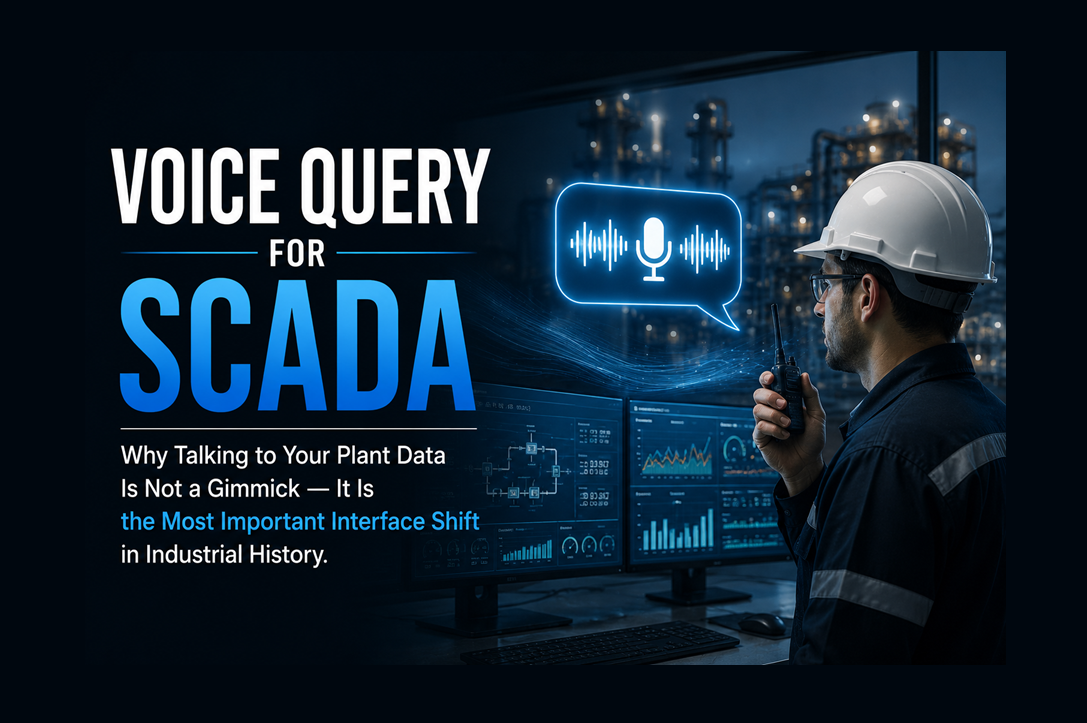
Every major interface revolution in the history of computing made the same move: it removed a barrier between humans and information. The command line gave way to the graphical interface. The graphical interface gave way to the touchscreen. The touchscreen is giving way to voice — and on the plant floor, where the people who most need data access are standing next to equipment with both hands occupied, voice is not the next interface evolution. It is the first interface that actually fits the job.
Voice Query · SCADA · HMI · Industrial AI · Operator Interface · Hands-Free Industrial · Sasquatch Labs Industrial Series · July 2026
- The interface problem nobody is talking about
- Why screens fail the people who need data most
- What voice query actually changes for plant operators
- Why this is not a gimmick: the physical reality of plant floor work
- What voice query for SCADA actually sounds like in practice
- The hardware context: voice is arriving from multiple directions
- What makes voice query work in industrial environments
- Voice query vs. voice control: an important distinction
- Who benefits most — and who benefits last
- How Valak implements voice query for SCADA
- Frequently asked questions
The Interface Problem Nobody Is Talking About
There is a consistent gap in the industrial AI conversation that rarely gets named directly. The technology side of the conversation focuses on architectures, protocols, data pipelines, and AI model capabilities — all of which matter. The business side focuses on ROI, OEE improvements, maintenance cost reductions, and operational efficiency — all of which also matter. What both sides tend to skip is a more fundamental question: does the interface through which operators interact with all of this technology actually fit the physical environment and the physical constraints of the people using it?
The answer, for the vast majority of industrial AI tools deployed today, is no. And the reason is not that the technology is immature or the AI is insufficient. It is that every industrial AI product currently being marketed to plant floors was designed around a screen — a workstation, a tablet, a monitor in a control room. The user sits in front of a screen, types a query or navigates a dashboard, and receives a visual response. That interaction model works well in an office. It works adequately in a control room. It breaks down entirely in the physical plant environment where the data actually matters most — standing next to a vibrating compressor, in a noisy process area, wearing gloves and a hard hat, with the equipment you need to query on your right and the nearest workstation a three-minute walk away.
Voice query for SCADA is the interface design response to that physical reality. It is not the next feature on a product roadmap. It is the recognition that the screen-first interface model has a structural accessibility gap in industrial environments — and that closing that gap requires a fundamentally different interaction modality, not a better screen.
Why Screens Fail the People Who Need Data Most
To understand why voice matters, it helps to be precise about where the screen-first interface model actually fails — because it is not an abstract failure. It is a documented, specific set of physical constraints that affect a large class of plant floor workers in predictable and consistent ways.
The hands problem
Industrial work is physical work. A maintenance technician inspecting a pump seal has both hands on the equipment. A process operator managing a valve lineup has hands occupied with equipment. An instrumentation technician tracing a signal path through a junction box is using both hands to probe and read. In each of these situations, the person doing the work cannot simultaneously interact with a keyboard or touchscreen. They have to stop what they are doing, physically move to a workstation or reach for a tablet, complete the data query, and return to the task — losing physical and situational contact with the equipment they were assessing in the process. Voice query eliminates that break in the workflow entirely.
The PPE problem
Personal protective equipment is not optional on most plant floors — it is regulatory, it is safety-critical, and it is designed without any consideration for keyboard interaction. Heavy gloves that are mandatory in chemical and process environments make touchscreen interaction impractical or impossible. Hearing protection in noisy environments creates a communication barrier that complicates voice interaction — but industrial voice technology has been specifically engineered around this constraint in a way that touchscreen technology has not. The RealWear Navigator Z1, for example, is engineered for hands-free voice control in noisy environments specifically for use with hard hats, hearing protection, and other PPE — noise-canceling microphone arrays designed for environments with up to 95dB ambient noise. The industrial voice hardware ecosystem has solved the PPE problem. The SCADA interface ecosystem has not.
The distance problem
In a large process plant, the equipment generating the most operationally relevant data may be hundreds of meters from the nearest workstation with historian access. The operator or technician on the floor has to choose between staying with the equipment — where their presence, judgment, and physical assessment are most valuable — and going to retrieve the data that would inform their assessment. Voice query eliminates that choice. The data query happens where the person is, not where the workstation is.
The cognitive load problem
Operating industrial equipment under abnormal conditions is cognitively demanding. Asking an operator in the middle of managing a process deviation to also navigate a historian query interface — remembering tag names, setting time windows, interpreting trend charts — is adding cognitive load at precisely the moment when cognitive resources are most constrained. Voice query, designed correctly, reduces cognitive load: the operator describes what they need in plain language, and the system handles the retrieval and interpretation.
Screen-first SCADA interfaces provide excellent data access to the people who are already in the control room — the people who are, by definition, farthest from the equipment and often most able to wait for information. They provide poor or no data access to the people standing next to the equipment — the people who are closest to the situation and most need information in the moment. Voice query inverts this asymmetry.
What Voice Query Actually Changes for Plant Operators
Voice query for SCADA is not primarily a speed improvement — though it is faster. It is primarily an access improvement. It makes data accessible to users and in contexts that were previously excluded from data access entirely.
The change is most clearly visible when you look at specific user personas and what their data access situation actually looks like today versus with voice query:
Today: Equipment access, data blindness
Standing at a pump with vibration concerns, no workstation nearby, cannot leave without losing physical assessment context. Has to guess or call the control room and wait.
With voice query: Data at the equipment
Asks aloud what the vibration trend looked like over the last 30 days on this pump, receives the answer through an earpiece or wearable, makes maintenance decision without leaving the equipment.
Today: Sequential access
Can monitor the immediate equipment via local indicators. Historical context, trend comparison, and alarm history require a trip to the control room or a call to the historian-literate engineer.
With voice query: Contextual access
Notices an unusual reading on a local indicator, immediately asks aloud whether this has happened before and what followed it, gets a data-grounded answer without leaving the equipment location.
Today: Control room dependent
Making rounds through the plant, relying on what the control room operators can relay over radio and what the local instruments show. Historical context is unavailable in the field.
With voice query: Mobile intelligence
Carries full historian query capability through the plant on rounds. Can ask site-wide questions — “anything trending abnormally on the north side of the plant right now?” — and receive answers without returning to the control room.
Why This Is Not a Gimmick: The Physical Reality of Plant Floor Work
Voice interfaces have a credibility problem in industrial contexts. Consumer voice assistants — Siri, Alexa, Google Assistant — have been promising hands-free convenience for over a decade and have delivered it inconsistently enough that many technically sophisticated industrial professionals treat “voice interface” as a category associated with unreliable demos and frustrated consumer experiences. That skepticism is understandable and largely earned — for consumer voice assistants.
It does not apply to the industrial voice category that has emerged in 2025 and 2026, which is built on a fundamentally different technical foundation and a fundamentally different deployment philosophy.
HMIs are evolving to resemble familiar consumer devices with touchscreen interfaces, gesture controls, and voice commands, while AI applications for predictive maintenance and anomaly detection are beginning to emerge. This observation from Automation World’s 2025 analysis of HMI/SCADA trends reflects a genuine industry shift — but it understates the velocity. By 2026, voice in industrial settings has moved from an emerging feature to an active deployment category, driven by hardware that was specifically designed for industrial noise environments, and by the convergence of voice with agentic AI that can actually answer complex industrial data questions rather than just execute simple commands.
By 2026, the benchmark for a successful voice user interface has shifted from simple command recognition to agentic AI systems that can autonomously complete complex tasks. That shift is the key distinction between the consumer voice assistant model and what industrial voice query represents. Consumer voice assistants recognize commands. Industrial agentic voice query reasons toward answers — understanding what the operator needs, retrieving the relevant data from the appropriate source, and synthesizing a direct response. The difference is the same as the difference between a light switch and an electrician.
The industrial environment presents three specific challenges that consumer voice technology never solved and that industrial voice technology has now addressed:
- Noise levels. Industrial environments routinely exceed 85dB — the threshold at which consumer voice recognition degrades sharply. Industrial voice hardware uses directional microphone arrays, noise cancellation algorithms trained specifically on industrial acoustic environments, and bone conduction technology to maintain recognition accuracy in environments that would defeat any consumer device.
- Domain vocabulary. Industrial queries use domain-specific terminology — tag names, equipment designations, process variable names, alarm codes — that consumer voice models were never trained on. Industrial voice AI tuned for plant-floor vocabulary and paired with agentic reasoning that can interpret intent rather than matching exact phrases performs categorically differently from consumer voice recognition.
- Safety constraints. Voice control of safety-critical equipment requires fail-safes, human-in-the-loop confirmations, and validation protocols that consumer voice systems were never designed for. Industrial voice query — distinguished carefully from voice control, as discussed later — addresses a different category of interaction where the safety stakes are managed through the human decision loop rather than automated execution.
What Voice Query for SCADA Actually Sounds Like in Practice
Abstract capability descriptions are less useful than concrete examples. Here is what voice query for SCADA actually looks and sounds like when deployed in a real plant environment:
A maintenance technician is standing at Compressor 7 on the north train, noticing that the bearing housing feels warmer than usual. She cannot leave — she is mid-inspection with both hands on the equipment. She speaks into her wearable headset:
“What has the bearing temperature been on Compressor 7 for the last two weeks, and did it look like this before the bearing failed in November?”
The system retrieves the bearing temperature trend from the historian for the specified period, compares it to the pre-failure pattern from November, and responds: “Bearing temperature on Compressor 7 has increased 4.2 degrees over the past 11 days, currently reading 71.3 degrees. The November pre-failure pattern showed a similar gradual rise over 14 days, reaching 74 degrees before the failure event. Current trajectory matches the November pattern at approximately day 11 of 14.”
The technician has a data-grounded basis for a maintenance escalation recommendation, made at the equipment, without stopping the inspection to go retrieve the information.
A field operator on the west unit notices that a pressure reading on his local gauge is higher than he expects for current operating conditions. He cannot immediately identify whether this is within normal variation or something to report. He speaks to his wearable:
“Is the suction pressure on West Unit Feed Pump 2 outside normal range right now, and has it been trending up this shift?”
The system queries the live OPC UA tag for the relevant pump and the historian for the current shift’s trend: “Current suction pressure on WU-FP-2 is 4.7 bar, which is 0.8 bar above the 12-month average for current flow rate conditions. Pressure has been trending upward since 14:20 — approximately 2.5 hours. No alarm threshold has been breached. Similar readings in the past 12 months have typically preceded filter maintenance requirements.”
The operator now has specific, data-grounded information to relay to the control room and to include in his written observation — without a trip to the control room and without calling the historian engineer.
A night shift supervisor is walking through the plant at 03:00 during his rounds. He wants to know the plant’s current status without returning to the control room. He speaks:
“Give me a quick summary — is anything trending outside normal parameters on either train right now?”
The system queries active tag values across both trains against their recent baseline ranges: “Two items of note: bearing temperature on South Train Compressor 3 is 3.1 degrees above its 30-day average — not in alarm but has been rising gradually for 6 hours. North Train cooling water flow has been 4% below design rate since approximately 01:45. All other monitored parameters are within normal ranges.”
The supervisor has a current, data-grounded picture of the plant state without going to the control room, and knows specifically where to direct his attention during the remainder of the round.
The Hardware Context: Voice Is Arriving from Multiple Directions
Voice query for industrial SCADA does not require any specific hardware — it can be implemented on a smartphone, a tablet, a ruggedized handheld, or a headset. But the hardware ecosystem supporting it has developed substantially in 2025 and 2026, providing context for how organizations are thinking about deployment.
RealWear Arc 3
Launched December 2025 with Ari OS. See-through display, double retina resolution, natural language AI controls. PPE-compatible, voice-controlled, designed for manufacturing, energy, utilities, and construction.
RealWear Navigator Z1
Voice-controlled hands-free platform for noisy industrial environments. IP66 ruggedization, full-shift battery life, hot-swappable batteries, noise-canceling microphone array rated for up to 95dB ambient noise.
Vuzix M4000
PPE-compatible smart glasses with 100% voice-controlled interface, advanced noise cancellation, and operating temperature range -20 to 45 degrees Celsius suitable for outdoor industrial environments.
The industrial smart glasses category has matured from speculative pilot deployments into mainstream operations technology in 2026. Three things drove the shift: hardware that genuinely works in industrial noise environments, software ecosystems that support the connected worker platforms organizations already use, and a generation of frontline workers who are comfortable with voice-first interaction in other parts of their lives. That maturation is relevant for voice query specifically because the hardware infrastructure for voice-first industrial interaction — the headsets, the microphone arrays, the noise cancellation systems — is being deployed independently of any specific SCADA AI product. Organizations equipping their frontline workers with voice-capable wearables are creating the deployment surface that voice SCADA query can run on.
For industrial leaders, the question is not whether voice interfaces will become relevant, but how to prepare for their integration. The first step is identifying processes where hands are busy, eyes should be focused, or information needs are immediate — these are the highest-value voice-first opportunities. Plant-floor SCADA and historian query meets all three criteria simultaneously: hands are typically occupied with equipment, eyes are focused on the physical situation, and the information need is immediate — the data question is arising from what the operator is observing right now, not from a scheduled analytical task.
What Makes Voice Query Work in Industrial Environments
Voice query for SCADA is not simply “add a microphone to a historian query tool.” Several specific technical and architectural requirements must be met for voice query to deliver reliable, useful results in real industrial environments:
Industrial acoustic noise handling
Consumer speech recognition models are trained on relatively clean audio environments. Industrial plants routinely run at 80 to 95dB or higher, with acoustic profiles that consumer models were never trained on. Industrial voice query requires noise cancellation algorithms specifically calibrated for industrial acoustic environments — machinery hum, pneumatic systems, ventilation equipment — and microphone array configurations that isolate the speaker’s voice from ambient industrial noise.
Domain-specific language understanding
Industrial operators do not ask “what is the rotational speed of pumping unit number seven.” They ask “what’s the RPM on FP-7” or “how’s the speed looking on the north train feed pump.” Understanding industrial shorthand, equipment designations, and plant-specific terminology requires either domain fine-tuning of the underlying language model or a robust intent interpretation layer that maps colloquial plant floor language to the precise data source identifiers needed for historian query.
Agentic reasoning, not command matching
The gap between a voice command system and a voice query system is the gap between telling a system exactly what to do and asking a system a question. Command systems require the user to know the syntax — “query tag FP7.SPEED for the last 24 hours.” Query systems accept the intent — “how has the speed been on Pump 7 lately” — and figure out the rest. The latter requires agentic reasoning: interpreting the goal, identifying the data source, forming the query, retrieving the data, and synthesizing an answer. Without that agentic layer, voice input is just a more error-prone way to type a command.
Low-latency on-premises inference
A voice query system that takes fifteen seconds to respond is not useful in the middle of an active plant floor situation. Industrial voice query requires low-latency inference — which means the AI processing needs to happen close to the data source, not in a round-trip to a distant cloud platform. On-premises deployment of the agentic AI layer is not just a security requirement. It is a latency requirement: the response needs to arrive while the operator is still at the equipment, not after they have moved on.
Air-gapped operation
The voice query interaction — from spoken question through data retrieval to spoken answer — must be completable without any data leaving the plant network. A voice query system that routes the spoken question to a cloud speech-to-text service before querying the historian has introduced a cloud dependency and a potential data exposure that most industrial OT environments cannot accept. Industrial voice query must run fully on-premises, including the speech recognition, the intent interpretation, the historian query, and the response generation.
Voice Query vs. Voice Control: An Important Distinction
Every industrial voice conversation eventually reaches a question that is worth addressing directly: is voice query safe for industrial environments? The honest answer depends entirely on distinguishing between two very different capabilities that are often conflated under the “voice” label.
Voice query — asking a question and receiving information — and voice control — issuing commands that cause equipment to take action — are fundamentally different capabilities with fundamentally different safety profiles. This article is about voice query. Voice control of safety-critical equipment is a different problem entirely, with different validation requirements, different regulatory implications, and different risk management demands. Conflating the two is the most common source of unwarranted skepticism about voice in industrial settings.
Voice AI is best suited for information retrieval, procedural guidance, and initiating pre-approved, non-critical routines in controlled settings. For direct, safety-critical machine control, rigorous validation, fail-safes, and human-in-the-loop confirmations are essential. That distinction, from a 2026 analysis of voice AI in industrial settings, is exactly right. Voice query for SCADA is firmly in the first category — information retrieval. The operator asks a question. The system retrieves data and provides an answer. The operator makes a decision. Nothing in that chain involves the AI system taking action on plant equipment.
The safety profile of voice query is essentially the same as the safety profile of a phone call — the operator is receiving information that informs their judgment, and their judgment drives the action. The human remains fully in the decision loop. The AI’s role is to make the information retrieval faster and more accessible, not to remove the human from the process.
Who Benefits Most — and Who Benefits Last
The distribution of benefits from voice query for SCADA follows a predictable pattern based on how much time a user spends in the physical plant environment versus at a workstation with existing historian access.
The users who benefit most are the ones for whom data has been least accessible: field operators and maintenance technicians who spend most of their working hours in the physical plant, interacting with equipment, in environments where workstations are unavailable or impractical. For these users, voice query does not improve their data access. It creates data access where none previously existed.
The users who benefit meaningfully but less dramatically are shift supervisors making rounds and process engineers spending time at the equipment as well as at the workstation. They gain the ability to carry their data access capability with them rather than returning to a workstation for every query — a significant time and continuity benefit, though not as transformative as the baseline access improvement for field operators.
The users who benefit least are control room operators who already have excellent workstation access to historian and SCADA data. For them, voice query is a convenience improvement — being able to ask a question without typing it — rather than a fundamental access change. Their baseline situation was already good. Voice makes it slightly better.
This distribution matters for deployment prioritization. Organizations evaluating voice query for SCADA should identify the field operator and maintenance technician population first — these are the users for whom the value is largest and most immediate — and design the deployment around their specific physical environments, equipment, and workflows before expanding to the control room population.
How Valak Implements Voice Query for SCADA
Valak, built by Sasquatch Labs, supports natural-language and voice query as co-equal interaction modalities — not as a text-first system with voice bolted on as a secondary feature, but as a system designed from the ground up for the reality that different users in different environments need to interact with plant data in different ways.
The voice query implementation addresses each of the technical requirements described above. The speech processing is designed for industrial acoustic environments — not consumer noise profiles. The intent interpretation layer handles plant-floor colloquial language and maps it to the appropriate OPC UA, AVEVA PI, or GE Proficy query without requiring the user to know tag syntax. The agentic reasoning layer operates fully on-premises, meaning the entire interaction from spoken question to spoken answer happens inside the plant’s own network boundary with no data crossing the network perimeter. And the response latency is optimized for the plant floor use case — fast enough that the operator receives their answer while still at the equipment where the question arose.
The air-gapped architecture that defines Valak’s security posture is also what makes its voice query implementation viable in regulated and security-sensitive industrial environments. A voice query system that routes speech through a cloud speech-to-text API is not deployable in environments where operational data cannot leave the plant network. Valak’s fully on-premises processing chain — speech recognition, intent interpretation, historian query, response generation — maintains the network boundary that industrial security requires.
- What Is Valak.ai? The Agentic AI Layer for HMI and SCADA
- What Is Agentic AI for Industrial Control Systems? A Complete Guide
- From Alarm Fatigue to Answers: How Conversational AI Is Changing Plant Operations
- 5 Questions Every Plant Manager Should Ask Their SCADA System
- Why Lossless Data Fidelity Is the Most Important Feature Nobody Is Talking About
Frequently Asked Questions: Voice Query for SCADA
1. What is voice query for SCADA?
Voice query for SCADA is the ability to ask questions about plant data — historian trends, live process values, alarm history, equipment status — by speaking in plain language rather than typing queries into a workstation or historian client. An agentic AI layer interprets the spoken question, identifies the appropriate data source, retrieves the relevant data, and responds with a direct spoken answer. It is designed for the physical reality of plant floor work where operators have both hands occupied, are in noisy environments, wear PPE that limits keyboard access, and are often distant from the nearest workstation.
2. Is voice query for industrial SCADA reliable in noisy plant environments?
Yes, when implemented with industrial-grade speech recognition rather than consumer voice technology. Industrial voice systems use directional microphone arrays with noise cancellation algorithms specifically calibrated for industrial acoustic environments — machinery hum, pneumatic systems, ventilation equipment. Dedicated industrial voice hardware like the RealWear Navigator Z1 and Arc 3 are engineered for environments with up to 95dB ambient noise. Consumer voice assistants like Siri or Alexa degrade significantly at these noise levels; industrial voice systems maintain recognition accuracy because they were specifically designed for these environments.
3. What is the difference between voice query and voice control for industrial systems?
Voice query involves asking a question and receiving information — the operator remains fully responsible for any decision and action that follows. Voice control involves issuing commands that cause equipment or systems to take action. These are fundamentally different capabilities with different safety profiles. Voice query for SCADA is information retrieval: the operator asks about a trend, receives data, and makes their own decision. Voice control of safety-critical equipment requires rigorous validation, fail-safes, and human-in-the-loop confirmations as it involves automated action on physical systems. Voice query does not introduce the safety concerns associated with voice control because no automated action is taken on the plant based on the voice query interaction.
4. Does voice query for SCADA require special hardware?
No — voice query can be implemented on existing smartphones, ruggedized tablets, or handheld devices already present in many industrial environments. However, purpose-built industrial voice hardware provides significantly better results in demanding plant environments. Dedicated industrial headsets and smart glasses offer directional noise-canceling microphone arrays, PPE compatibility, hands-free operation, and IP-rated durability that consumer devices cannot match. The choice of hardware depends on the specific plant environment, noise levels, and the physical workflows of the operators using the system.
5. Can voice query work with existing AVEVA PI, GE Proficy, or OPC UA systems?
Yes. Voice query is an interface modality — the spoken question is interpreted by an agentic AI layer that then queries the plant’s existing data sources using their native protocols. An agentic AI layer like Valak connects to AVEVA PI, GE Proficy, and OPC UA systems using those systems’ native interfaces, regardless of whether the query arrives via text or voice. The underlying data connection to the historian is the same in both cases; the difference is only in how the query is expressed and how the answer is delivered.
6. Can voice query for SCADA work in an air-gapped plant environment?
It can — but only if the entire voice query processing chain runs on-premises. A voice query system that routes speech through a cloud speech-to-text API, or routes the query through a cloud-hosted AI inference service, has introduced a cloud dependency and a data export that most air-gapped OT environments cannot accept. Industrial voice query designed for air-gapped environments must perform speech recognition, intent interpretation, historian query, and response generation entirely within the plant’s own network boundary. Valak’s on-premises architecture supports voice query in air-gapped environments because all processing happens inside the plant network.
7. Who benefits most from voice query for SCADA?
The greatest benefit goes to field operators and maintenance technicians who spend most of their working hours in the physical plant environment — away from workstations, in noisy conditions, wearing PPE, with hands occupied by equipment work. For these users, voice query does not improve data access — it creates data access where none previously existed in a practical sense. Shift supervisors making rounds benefit significantly as they can carry historian query capability through the plant rather than returning to the control room for every data question. Control room operators who already have excellent workstation access benefit least, gaining convenience rather than a fundamental access change.
8. What industrial sectors are adopting voice interfaces fastest in 2026?
Manufacturing, energy, utilities, and construction have the highest current deployment rates for industrial voice interfaces, reflecting both the physical plant floor requirements common to those sectors and the maturation of industrial voice hardware specifically designed for their environments. The VUI market research published in late 2025 documents that manufacturing facilities are integrating voice-enabled maintenance systems allowing technicians to retrieve operational data without stopping equipment processes, citing this as one of the primary industrial growth drivers for the voice interface category. Chemical, pharmaceutical, and food and beverage sectors are also active, driven by the combination of hands-busy operating environments and stringent documentation requirements where voice-to-text capture reduces recording burden.
9. How does voice query for SCADA handle plant-specific terminology and tag names?
Effective industrial voice query requires a domain interpretation layer that maps the colloquial language operators actually use — equipment nicknames, abbreviated tag names, plant-specific shorthand — to the precise data source identifiers needed for historian query. This is distinct from raw speech recognition accuracy and is one of the primary technical challenges in industrial voice query deployment. Systems that require the operator to speak the exact tag name or system-formatted query are unlikely to deliver usable results because operators do not naturally communicate in tag name syntax. Agentic intent interpretation — understanding what the operator means rather than matching what they said to a command list — is what makes voice query practical for real industrial vocabulary.
10. Is voice query for SCADA just a novelty or is it genuinely practical in 2026?
Voice for industrial information retrieval has crossed from novelty to practical deployment in 2026, driven by three converging factors: industrial voice hardware that genuinely works in noisy plant environments, agentic AI systems that can interpret intent rather than just recognize commands, and a growing recognition that screen-first interface designs have structural accessibility gaps in physical plant environments. The 2026 VUI market reflects this maturation — manufacturing is cited as one of the primary industrial growth segments, and connected worker platforms are deploying voice-capable hardware at scale across multiple sectors. The combination of RealWear’s December 2025 Arc 3 launch with natural language AI controls, and the broader agentic AI development across industrial platforms, marks 2026 as the year voice moved from pilot deployment to operational standard in the industrial connected worker category.
Give Your Plant Floor Operators a Voice
Valak brings natural-language and voice query to your OPC UA, AVEVA PI, and GE Proficy systems — fully on-premises, air-gapped, designed for the physical reality of industrial environments. No workstation required.