

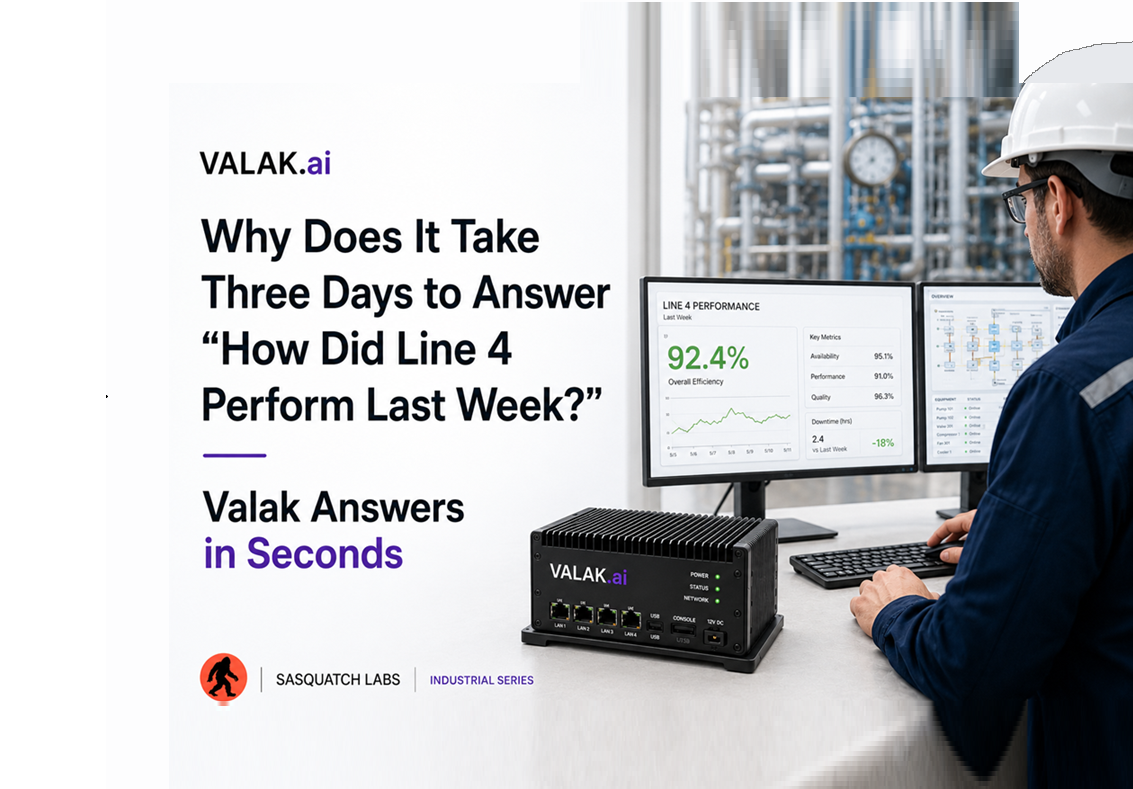
Your plant ran last week. The data exists. It sits in your historian, your SCADA, and your DCS. So why does getting a straight answer still take two days, three people, and a spreadsheet?
July 4, 2026 — 7 min read
Your plant ran last week. The data exists. It sits in your historian, your SCADA, and your DCS. So why does getting a straight answer still take two days, three people, and a spreadsheet?
Sound familiar?
“It takes us a long time to figure out how our lines performed last week. We are waiting on different people and different systems just to pull it together. Surely there is a better way.” This is one of the most common things we hear from operations managers, plant engineers, and production leads. Not once. Every single week.
The big picture
The question is simple. The answer should be instant. The process is broken.
Most manufacturing plants are not short of data. A modern line generates thousands of signals per second: temperature, pressure, throughput, cycle time, reject rate, energy draw, conveyor speed. The historian captures all of it. The SCADA sees all of it. The DCS records all of it.
And yet when a production manager asks “how did Line 4 perform last week,” the answer requires logging into three systems, finding the right tags, exporting the data, opening Excel, and waiting for the one engineer who knows where everything lives. The data is there. The access is not.
Valak changes one thing: it puts a natural language interface on top of every system you already have. You ask the question in plain English. Valak finds the tags, queries the historian, and answers. No exports. No spreadsheets. No waiting.
Why it matters
A question that takes three days to answer is a question that stops getting asked.
Operations decisions are time-sensitive. When it takes two days to find out how Line 4 performed last week, that information arrives too late to act on. The line has already run another week. The same issue has happened again. The opportunity to intervene has passed.
The cost is not just the time. It is the decisions that do not get made because the data is too slow to reach the people who need it. Production managers stop asking the questions they cannot get answered quickly. Engineers stop investigating patterns they cannot easily pull. Plant performance stays where it is because the feedback loop is measured in days, not minutes.
The plants that are pulling ahead in 2026 are the ones where operations decisions happen on the same timescale as operations. That requires answers in seconds, not days.
What is happening
A five-step process that should not exist at all.
Here is the actual sequence of events when a production manager asks “how did Line 4 perform last week” in a plant without Valak:
-
Step 1: The manager sends a message to the process engineer asking for last week’s Line 4 performance data. The engineer is in the middle of something else. The message sits for a few hours.
-
Step 2: The engineer opens the historian client. Line 4 has 340 active tags. Finding the right throughput, reject rate, and cycle time tags requires knowing the tag naming convention, which was set up in 2019 by someone who no longer works there.
-
Step 3: The engineer exports the data to a CSV. The historian exports in the historian’s native format, which requires a separate tool to open. The time range covers seven days, which means a large file that takes time to process.
-
Step 4: The CSV goes into Excel. The engineer builds a pivot table, creates the charts the manager wanted, and writes up a short summary. This takes another hour or two.
-
Step 5: The manager receives the spreadsheet. It is now Thursday. The data is from last Monday through Sunday. The next week is already halfway done.
Every step in this process is unnecessary. Not because the people involved are doing it wrong, but because the systems were never designed to answer questions directly. They were designed to record data. Answering questions was always a human job.
Valak changes what a system can do.
How it works: Valak on the plant floor
Read-only. Air-gapped. Live in an hour. No changes to your existing systems.
Valak connects to your existing historian, SCADA, and HMI via OPC-UA. It does not replace anything. It does not write to your control systems. It does not require integration work from your OT team. It sits alongside what you already have and makes it answerable.
Once connected, a production manager can open the Valak interface and type or speak a question in plain English.
Example query:
“What was the average throughput on Line 4 last week, and how does it compare to the week before? Which shift had the highest reject rate?”
Valak identifies the relevant tags across the historian, queries the correct time range, calculates the comparison, identifies the shift with the highest reject rate, and returns the answer in plain language with the supporting numbers. The whole process takes under ten seconds.
The process engineer is not involved. The CSV export does not happen. The Excel pivot table does not get built. The manager has the answer before they have finished their coffee.
Process Comparison
| Step | Old way | With Valak |
| Find the right data source | Log in to historian client, navigate tag tree | Valak knows your tag structure |
| Identify the relevant tags | Know the naming convention or ask someone who does | Valak maps tags to plain English |
| Pull the correct time range | Export to CSV, process file | Instant query across any range |
| Calculate the comparison | Build pivot table in Excel | Valak returns the comparison directly |
| Get the answer to the manager | 2 days, 1 engineer, 1 spreadsheet | Under 10 seconds, no one else needed |
The bottom line
The bottleneck was never the data. It was the access layer between the data and the person who needed it.
AVEVA PI, GE Proficy, Ignition, OSIsoft historians: these are excellent systems. They have been capturing process data reliably for years. The problem is not that they do not have the data. The problem is that accessing that data requires specialist knowledge of tag naming, query syntax, and export formats that most of the people who need the answers simply do not have.
Valak does not replace your historian. It makes your historian answerable to everyone in your organisation, not just the engineers who built it. A production manager can ask. A shift supervisor can ask. A plant director can ask. The answer comes back in seconds, in plain language, every time.
The three-day reporting cycle is not an engineering problem. It is an access problem. And access problems have a straightforward fix.
What’s next
Once the access problem is solved, a different set of questions becomes possible.
The first thing operations teams notice after deploying Valak is not just that existing questions get answered faster. It is that they start asking questions they had stopped asking because the answer was too hard to get. Questions like:
-
“Which line has had the most unplanned stoppages in the last 90 days, and what time of day do they tend to happen?”
-
“How does our current energy draw on Line 2 compare to the same period last year?”
-
“Which raw material batch had the highest correlation with elevated reject rates in Q2?”
These are not exotic questions. They are the questions that operations managers have always wanted to answer. They just required an engineer, a spreadsheet, and two days. With Valak, they take ten seconds.
The plants that will operate most efficiently in the next five years are the ones where every person with a question about the process can get an answer without filing a request. That is what Valak is built to deliver.
See how fast Valak answers your questions
We connect Valak to your existing historian or SCADA in under an hour. Read-only. Air-gapped. No changes to your existing systems. Ask your first question the same day.
valak.ai
2026 Valak AI by Sasquatch Labs, Inc. Patent-pending
valak.ai – blog.valak.ai