

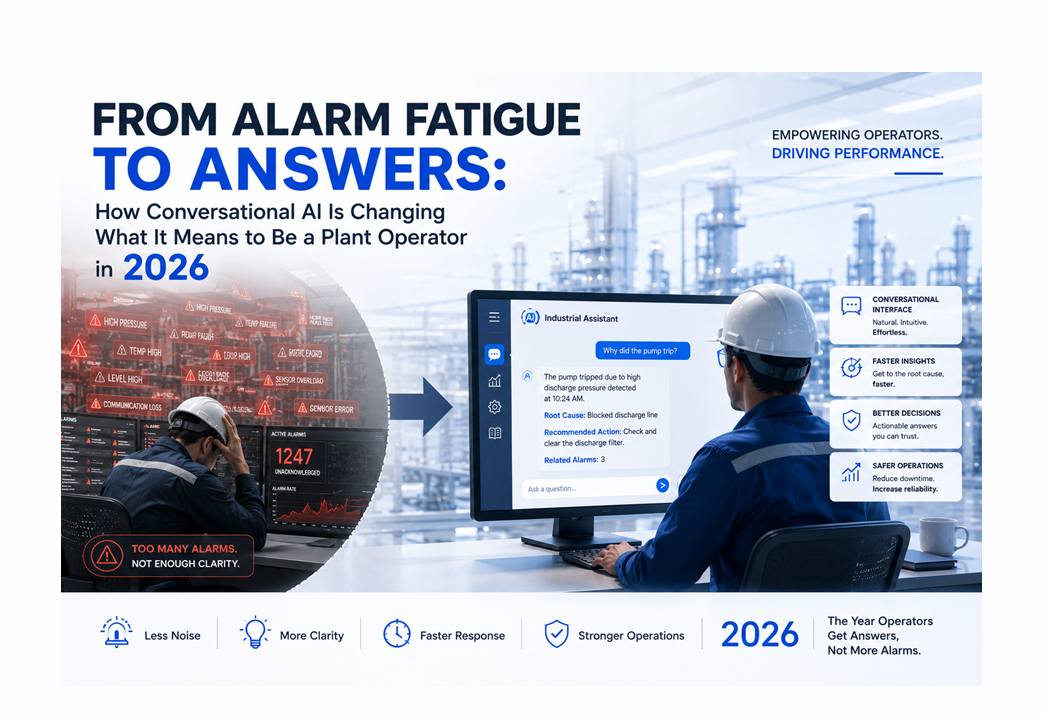
For decades, the people closest to industrial equipment have been the least able to ask it a direct question. An operator who knows something is wrong but cannot quickly find the data to confirm it — and cannot get the right engineer on the phone at 2 a.m. — is a systemic problem. Conversational AI is starting to solve it in ways that alarm management systems never could.
Plant Operations · Operator Experience · Alarm Fatigue · Conversational AI · SCADA/HMI · Workforce · Sasquatch Labs Industrial Series · July 2026
Contents
- What a shift actually feels like
- The alarm numbers are worse than most people realize
- What alarm fatigue actually costs
- When alarm fatigue becomes a safety record
- Why alarm management alone has never solved this
- The second, quieter problem: data access
- The Great Crew Change is making both problems worse
- What conversational AI actually changes for operators
- Three real scenarios, before and after
- How Valak approaches this
- What conversational AI for operators is not
- Frequently asked questions
What a Shift Actually Feels Like
Picture a night shift at a process plant — a refinery, a water treatment facility, a food manufacturing line, a pharmaceutical site. It is 2:30 a.m. There are two operators in the control room. The screens are full. Alarms have been firing on and off since midnight, most of them the same three or four standing alarms that have been present for weeks because no one has had time to rationalize the thresholds. One operator is watching the trend lines. The other is on the phone with maintenance about a pump that has been making an intermittent noise on Line 4.
Something changes. A value that should not be moving begins to drift. It is not in alarm yet — the threshold is set two standard deviations above normal, and the drift is subtle, only about 15% above the recent average. The experienced operator notices it because she has run this unit for nine years and recognizes the pattern. She wants to check whether this reading has drifted like this before, and whether the last time it did, it preceded the compressor trip that cost three hours of production back in March.
To answer that question, she would need to open the historian client, remember the correct tag name — which is in the old nomenclature because the naming convention changed two years ago and the historian was never updated — pull a trend over the last six months, find the March event, and correlate the two patterns. That is a fifteen-minute task on a good day, in daylight, with access to the engineer who knows the tag structure. At 2:30 a.m., with two operators and a maintenance call already in progress, it does not happen. She makes a judgment call based on experience and monitors it manually.
Sometimes that is the right outcome — experienced operators make good judgment calls. But sometimes it is not. And either way, it illustrates the gap that has existed at the heart of industrial operations for thirty years: the person closest to the equipment, with the most context about what is actually happening, has the least practical ability to access the data that would help her act with certainty instead of intuition.
The Alarm Numbers Are Worse Than Most People Realize
Before discussing what is changing, it is worth establishing how significant the alarm fatigue problem actually is — because the scale is larger than most non-operators appreciate.
3,000–5,000 alarms generated per shift in a typical automotive assembly plant, according to ISA research
Under 15% of those alarms acknowledged meaningfully by operators, per ISA studies — the rest are nuisance, stale, or cascading
1 per minute maximum alarm rate a human operator can process before cognitive overload sets in, per ISA-18.2 and the Control Room of the Future initiative
10 per minute typical alarm rate during a plant upset — the exact moment operators need the clearest possible situational awareness
That last pair of numbers is the one that defines the structural problem. ISA-18.2 and the Control Room of the Future initiative quantified it precisely: operators can process a maximum of roughly one alarm per minute before cognitive overload sets in. A system generating 10 or 20 alarms per minute during a plant upset puts operators in an impossible position.
Read that again. At the exact moment when clear situational awareness matters most — when something is going wrong and decisions need to be made quickly and correctly — the alarm system buries the operator in ten times more information than the human cognitive system can process. The most critical alerts are competing for attention with dozens of nuisance alarms that have been standing for weeks, stale alarms that already resolved, and cascading alarms that are all downstream effects of the same root cause.
Nuisance alarms alone can account for over 90% of total alerts in poorly rationalized systems. The global Smart SCADA Alarm Management market was valued at USD 2.5 billion in 2025 and is growing at 5% annually — driven largely by the industrial sector’s persistent failure to tame alarm overloads. The fact that this is a USD 2.5 billion market in 2025 tells you something important: the problem has been recognized, significant investment has been directed at it, and it has not been solved.
What Alarm Fatigue Actually Costs
Alarm fatigue is sometimes treated as an operator comfort issue — an ergonomics problem, a quality-of-life concern for the people sitting in control rooms. That framing dramatically underestimates what it actually costs.
The costs are layered across several categories, and they compound in ways that are not always visible until after an incident has occurred:
Direct production costs
In high-stakes environments such as oil and gas pipelines, where alarm rates can spike to 10 per minute during flood events, cognitive overload prevents operators from identifying root causes and taking corrective action in time to prevent unplanned shutdowns, with downtime costs estimated in the millions annually. Every unplanned shutdown that could have been prevented by a faster, more confident operator response is a direct production loss. Every quality deviation that goes uncaught because an operator was managing a screen full of alarms rather than the one value that mattered is a cost that shows up in the quality report, not the alarm log.
Missed maintenance signals
Missed alarms lead to equipment damage, scrap production, unplanned stoppages, and in some cases safety incidents. A single missed high-temperature alarm on a welding cell or a pressure fault on a hydraulic press can cascade into hours of lost production and thousands of dollars in repairs. Poor alarm management also makes troubleshooting harder because operators cannot distinguish between root causes and downstream effects when dozens of alarms fire simultaneously.
Operator burnout
There is a human cost to chronic alarm overload that does not appear on a balance sheet until it shows up in turnover, sick leave, and the gradual erosion of the experienced workforce. Operating in a permanently high-alert cognitive state across twelve-hour shifts is physiologically and psychologically demanding. The operators who manage it best are the ones with enough experience to have developed their own internal filters — knowing which alarms to mentally mute because they are never actionable. That informal filtering is itself a risk: the filter that works 99% of the time is also the one that misses the 1% case where the ignored alarm was genuinely important.
Regulatory exposure
In highly regulated environments, repeated spurious alarms complicate process investigations and regulatory compliance. ISA-18.2 has become recognized and generally accepted good engineering practice by both insurance companies and regulatory agencies. Organizations that cannot demonstrate alarm system performance aligned with ISA-18.2 benchmarks face growing insurance and regulatory exposure — not as a theoretical future risk but as an active 2026 concern in process industries.
When Alarm Fatigue Becomes a Safety Record
The connection between poor alarm management and serious industrial incidents is documented and specific, not speculative.
These are not ancient history. They are cited by regulatory agencies, insurance underwriters, and the ISA itself as the motivating cases for the development of ISA-18.2. Both OSHA and the Health and Safety Executive have identified the need for improved industry practices to prevent these incidents, and ISA-18.2 has become recognized and generally accepted good engineering practice for process industries.
The point is not to suggest that conversational AI would have prevented these specific incidents — that would be an overreach. The point is that the pattern connecting alarm overload, operator cognitive fatigue, missed signals, and serious outcomes is well-established and continues to manifest in plants that have not solved the underlying problem.
Why Alarm Management Alone Has Never Solved This
The alarm management industry has been working on this problem seriously for thirty years. ISA-18.2 was published in 2009 and has been continuously refined. Alarm rationalization services exist. Alarm management software has become a USD 2.5 billion market. And yet the problem persists at scale.
Why? Because alarm management is, by its nature, a reactive and structural intervention. You rationalize the alarm database — identify nuisance alarms, adjust thresholds, implement suppression logic — and for a period, the alarm rate comes down. Then the plant changes. Equipment ages. Production targets shift. New instruments are added. The control system is modified. And the alarm database, which requires continuous attention to remain rationalized, begins to drift back toward overload. Alarm management is not a once-and-done activity — it is a process requiring continuous attention. Most plants do not have the dedicated resources to give it that attention continuously.
The deeper issue is that alarm management operates on the premise that the right response to information overload is to reduce the information. That premise is correct as far as it goes — fewer nuisance alarms is better than more nuisance alarms. But it does not address the second, separate problem: that even with a well-rationalized alarm system, an operator who needs to ask a question about plant data still cannot do so without specialist knowledge, specialist tools, and usually specialist help.
The Second, Quieter Problem: Data Access
Alarm fatigue is visible. It is loud. It shows up in incident reports and regulatory inspections and alarm rate KPIs. The data access problem is quieter, which is part of why it has persisted even longer.
The data access problem is this: the historians, SCADA systems, and operational databases that industrial plants run contain an enormous volume of information that could support better decisions — trend analysis, equipment history, process correlations, maintenance records. Almost none of it is accessible to the people who most need it, in real time, without specialist mediation.
Accessing a historian meaningfully requires knowing the tag naming convention, which varies by plant, by system, and often by how thoughtfully the original engineer set it up. It requires knowing which historian client to use and how to navigate it. It requires knowing what time window is appropriate for the question being asked. And it requires being able to interpret the result in the context of what is actually happening on the plant floor at that moment.
That entire skill set is concentrated in a small number of people. Senior operators carry deep pattern recognition built over years of running a unit. They know the informal adjustments that keep a process stable near its limits and the failure modes that never made it into an FMEA because they were caught early and handled quietly. This forms the core of the industrial workforce knowledge gap.
When those people are available — during day shift, when the plant engineering team is in — the system functions. When they are not available — at 2:30 a.m., during vacations, after retirements — the data is effectively inaccessible to everyone else. The historian is full. The answers are in there. No one can reach them without the keys that only a few people hold.
The Great Crew Change Is Making Both Problems Worse
The workforce dynamics around industrial operations are moving in one direction, and it is not the direction that makes either the alarm fatigue problem or the data access problem easier to manage.
When retiring operators leave these roles, the expertise required to run a unit safely and efficiently near its operating limits leaves with them. Most of these deficits fail to appear on any balance sheet until after the operational damage is done. The informal knowledge — which alarm to mentally weight, which trend to check before accepting a reading at face value, which tag correlates with which downstream behavior — is not documented anywhere. It exists in the heads of people who are leaving the workforce in large numbers.
Deloitte research published in 2025 estimated that U.S. manufacturing may need approximately 3.8 million new workers between 2024 and 2033, with nearly half of those roles potentially going unfilled due to skills gaps. More than 70% of the U.S. power grid is at least 25 years old. Veteran workers understand these legacy systems, know how to troubleshoot complex issues, and bring historical context that cannot be easily replaced. Experts warn that the impending knowledge gap will place significant stress on plant operations and reliability.
The operator walking in to replace a thirty-year veteran does not have that pattern recognition. They have training, they have the manual, they have whatever onboarding the plant was able to provide. What they do not have is the years of accumulated experience that tells them which subtle signal in a trend line is worth calling someone about at 2 a.m. — and which one can wait for the morning handover.
For that operator, the data access problem is not an inconvenience. It is a daily operational challenge. They cannot compensate with experience they have not yet built. They need a better way to ask questions of the plant data while they develop it — and the current generation of SCADA interfaces and historian tools was not designed to give them one.
What Conversational AI Actually Changes for Operators
Conversational AI — and specifically agentic AI that can query plant data through natural language and voice — does not solve alarm management. That is a different problem, with its own engineering solutions. What it does is address the data access problem in a way that nothing before it has adequately addressed.
The change is deceptively simple to describe and surprisingly significant in practice: any operator, at any level of experience, can ask a question about plant data in plain language and get a direct answer, without knowing the tag structure, without opening a historian client, without calling the engineer who has been asleep for four hours.
That shift changes the operator experience in several specific ways:
Faster confirmation of intuitions
Experienced operators often know something is wrong before they can prove it. The value that looked slightly off, the sound that was a little different, the feeling that something has changed. Currently, confirming that intuition requires time, access, and skill. With conversational AI, it requires a question. The time between “something feels wrong” and “here is the data that confirms or refutes that” compresses from fifteen minutes to fifteen seconds.
Reduced reliance on the one person who knows
Every plant has that person — the engineer or experienced operator who is the de facto historian of the system, the one people call when they need to know what happened last time something behaved like this. Conversational AI does not replace that person. But it reduces the number of calls that need to happen in the middle of the night for routine data retrieval, allowing that person’s expertise to be applied to genuinely complex situations rather than to “can you find me the tag for Line 4 discharge pressure and pull the last six hours of trend data.”
A faster ramp for new operators
The gap between a new operator and a thirty-year veteran is not primarily about attitude or work ethic — it is about pattern recognition that takes years to build. Conversational AI cannot transfer that pattern recognition, but it can dramatically reduce the time new operators spend blocked on data retrieval questions while they are building it. An operator who can ask “has this behavior happened before and what followed it” is better positioned than one who has to wait until the morning shift to ask the right person.
Voice access in environments where keyboards do not work
A significant portion of the plant floor is not a comfortable desk with a keyboard and a historian client. It is a noisy, physical environment where operators are wearing gloves, standing next to equipment, and cannot type a query. Voice-based conversational AI turns the question of data access from a “go back to the control room” problem into something that can happen at the equipment, in the moment, while the situation is still developing.
Alarm management reduces the noise so operators can hear the signal. Conversational AI gives operators a way to ask follow-up questions about the signal once they have heard it. Both matter. They are not substitutes for each other — they address adjacent parts of the same underlying problem.
Three Real Scenarios: Before and After
Abstract descriptions of capability improvements are less useful than concrete examples of what a shift actually looks like differently. Here are three scenarios that represent common operator experiences, mapped against what changes with conversational AI access to plant data.
Scenario 1 — The subtle drift at 2 a.m.
The situation: An operator notices that the discharge pressure on a compressor has been drifting upward for the last forty minutes. It is not in alarm yet. She wants to know if this has happened before and what followed it.
Before conversational AI: She opens the historian client, searches for the tag name, remembers it was renamed two years ago and tries the old name, eventually finds it, pulls six months of data, looks manually for similar patterns, cannot be certain she has found the right events, calls the instrument engineer at home, gets a partial answer, and monitors manually while waiting for morning.
“Has the discharge pressure on Compressor 3 drifted more than 8% above baseline before, and what happened in the 24 hours after each time it did?”
The system queries the historian, identifies three prior events matching the pattern, notes that two of them preceded a seal fault event within eighteen hours, and surfaces the relevant trend segments for operator review.
After: The operator has an informed basis for a maintenance notification before the end of the shift, rather than a judgment call based on experience and instinct.
Scenario 2 — The alarm flood during a process upset
The situation: A trip on a process unit triggers a cascade of 40 alarms in ninety seconds. The operator needs to find the root cause and initiate recovery while managing the alarm flood.
Before conversational AI: The operator attempts to work through the alarm list manually, trying to distinguish root-cause alarms from downstream cascading effects, while physically acknowledging alarms to prevent the console from locking. The root-cause identification takes twelve minutes. Recovery begins at the fourteen-minute mark.
“What was the first abnormal reading before the trip, and which of the current alarms are cascading effects of that event versus independent faults?”
The system cross-references the alarm log with historian data to identify the initial deviation, surface it as the likely root cause, and distinguish the five genuinely independent alarms from the thirty-five downstream cascades that can be managed in sequence.
After: The operator has a prioritized picture of the situation within ninety seconds rather than twelve minutes. Recovery begins faster, with less cognitive load, and with a clearer record of the event sequence for the incident report.
Scenario 3 — The new operator’s first six months
The situation: A new operator, six months into the role, is on shift without the senior engineer available. A reading behaves in a way she has not seen before. She does not know if it is normal, abnormal-but-acceptable, or something that needs to be escalated now.
Before conversational AI: She checks the manual, does not find the specific situation, considers calling the senior engineer, decides not to because she is not sure it is worth interrupting, monitors it manually, and makes a note to ask about it at the morning handover. Sometimes that is fine. Sometimes it is not.
“Is this temperature reading on Heat Exchanger 7 within normal range for current operating conditions, and is there anything in the last 30 days that looks similar to what I’m seeing right now?”
The system confirms whether the reading is within the expected range for current production rate and ambient conditions, retrieves any similar events in the recent historical record, and notes whether any of them required operator action.
After: The new operator has a data-grounded answer to the question she was not confident enough to call about. Over hundreds of such interactions across six months, her pattern recognition builds faster because she has been getting confirmed data alongside each situation rather than waiting for the morning debrief.
The operator experience before
- Alarm floods during upsets with no fast way to separate root cause from cascades
- Data retrieval gated behind historian expertise few operators have
- Night shift decisions made on intuition when data is inaccessible
- New operators blocked on routine data questions for months
- Sole dependence on the one engineer who knows where everything lives
- Voice and physical environment incompatible with keyboard-based tools
The operator experience after
- Root-cause prioritization from natural-language query during alarm events
- Historian access by plain-language question, no tag knowledge required
- Night shift data questions answered in seconds, not hours
- New operators building pattern recognition faster with real-time data confirmation
- Expert bottleneck reduced to genuinely complex situations only
- Voice query available at the equipment, not just at the workstation
How Valak Approaches This
The scenarios above describe the operator experience that agentic AI for industrial control systems is designed to deliver. Valak, built by Sasquatch Labs, is the product in this space most specifically oriented toward the plant-floor operator as its primary user — rather than the engineer or data scientist that most industrial analytics platforms are designed around.
Valak’s positioning as an agentic AI layer for HMI and SCADA systems is directly relevant to the alarm fatigue and data access problems described in this article. It connects natively to the systems operators already work with — OPC UA, AVEVA PI, GE Proficy — without requiring those systems to be replaced or data to be migrated. The natural-language and voice query interface means the user does not need historian expertise to ask a question. The lossless data fidelity approach means the answer reflects the actual operational record, without summarization that could smooth over the specific anomaly the operator was trying to confirm or rule out.
The air-gapped, on-premises architecture means the system is available on night shift just as it is during the day — it does not depend on a cloud connection whose availability or latency might vary. And because all data stays within the plant network, there is no security trade-off involved in making plant-floor data more accessible to the people who need it.
None of that replaces alarm management engineering, ISA-18.2 rationalization work, or the development of experienced operators. What it does is fill the gap that those things have never filled: the ability of any operator, at any hour, to ask a direct question about plant data and get a direct, trustworthy answer.
Related reading
- What Is Valak.ai? The Agentic AI Layer for HMI and SCADA
- What Is Agentic AI for Industrial Control Systems? A Complete Guide
- OT Cybersecurity in 2026: Why Air-Gapped AI Is Non-Negotiable
- Valak vs. AVEVA AI Assistant: Which Industrial AI Fits Your Plant?
- Valak vs. Seeq: Two Different Philosophies for Industrial AI
What Conversational AI for Operators Is Not
It would be incomplete to describe what this technology changes without being clear about what it does not change and what it is not designed to do.
Conversational AI for plant operators is not a replacement for operator training and experience. The pattern recognition that a veteran operator has built over thirty years is not replicated by a tool that can answer data questions. Experience, judgment, and the physical intuition that comes from years around equipment remain irreplaceable. What conversational AI does is reduce the number of situations where an operator’s good judgment is blocked by an inability to access the data needed to act on it.
It is not an autonomous control system. Conversational AI in the context described here is an intelligence layer that answers questions — it does not take actions on the plant. The operator retains full authority over every decision. The AI retrieves and presents information; the human decides what to do with it.
It is not a substitute for proper alarm management. A conversational AI layer sitting on top of a chronically over-alarmed system does not fix the alarm problem. ISA-18.2 rationalization, threshold review, and alarm system lifecycle management remain necessary and independent activities. The conversational layer helps operators navigate a complex information environment; it does not redesign that environment.
And it is not a solution that delivers value automatically on day one without any organizational work. The quality of answers depends on the quality of the underlying data — a historian with poorly configured tags and naming convention inconsistencies is a harder problem to query, AI or otherwise. Organizations that have invested in data infrastructure get more value from the layer on top of it.
Frequently Asked Questions: Alarm Fatigue and Conversational AI for Plant Operators
1. What is alarm fatigue in industrial plant operations?
Alarm fatigue is the state of cognitive desensitization that occurs when operators are exposed to so many alarms that they begin to ignore them or respond to them less critically. It develops when alarm systems generate more notifications than human cognitive capacity can meaningfully process — ISA-18.2 research establishes that operators can handle a maximum of approximately one alarm per minute before overload sets in, while plant upset conditions can generate 10 or more alarms per minute. The result is that genuinely critical alarms compete for attention with dozens of nuisance, stale, or cascading alarms, and the critical ones are sometimes missed.
2. How many alarms does a typical industrial plant generate per shift?
Research from the International Society of Automation found that a typical automotive assembly plant generates between 3,000 and 5,000 alarms per shift, with operators meaningfully acknowledging fewer than 15% of them. In process industries such as oil and gas, alarm rates during upset conditions can spike to 10 per minute or higher. These numbers vary significantly by plant type and alarm management maturity, but poorly rationalized systems where nuisance alarms account for 90% or more of total alerts are a recognized and widespread problem across industrial sectors.
3. What incidents have been linked to alarm management failures?
Several major industrial incidents have been documented as having alarm management failures as a contributing factor. The BP Texas City Refinery explosion in 2005 killed 15 people and injured 180; the post-incident investigation identified that key level alarms failed to notify operators of dangerous conditions developing in the tower. The Buncefield Oil Depot fire in the UK resulted in losses exceeding GBP 1 billion, and investigators found it could have been prevented if the tank’s high-level alarm had functioned correctly. These cases directly motivated the development of ISA-18.2, the international alarm management standard.
4. What is ISA-18.2 and how does it address alarm fatigue?
ISA-18.2 is the International Society of Automation’s standard for alarm management in process industries, published in 2009 and continuously updated. It defines a lifecycle approach to alarm management covering philosophy, identification, rationalization, detailed design, implementation, operation, monitoring, assessment, and continuous improvement. It provides performance metrics — including acceptable alarm rates — and has been adopted as recognized and generally accepted good engineering practice by OSHA, the UK Health and Safety Executive, insurance companies, and regulatory agencies. It does not address the data access problem directly; it focuses specifically on reducing alarm overload and improving the quality and actionability of alarms that are presented to operators.
5. How is conversational AI different from better alarm management?
Alarm management and conversational AI address adjacent but distinct problems. Alarm management reduces the noise in the alert stream so operators can hear genuine signals more clearly. Conversational AI gives operators a way to ask follow-up questions about what they are seeing — checking historical context, correlating with other data sources, and confirming or ruling out hypotheses — without requiring specialist database access. Both are valuable; neither replaces the other. An operator who receives a well-rationalized alarm (alarm management working) and can then immediately ask the plant’s AI “has this happened before and what followed it” (conversational AI working) is in a substantially better position than one who has only one of those things.
6. Can a new operator benefit from conversational AI, or is it mainly for experienced staff?
Conversational AI may provide proportionally more value to new and less experienced operators than to veterans, because it fills exactly the gap that new operators feel most acutely: the inability to access historical data and operational context without specialist mediation. A new operator who can ask “is this reading normal for current conditions” and “has this pattern preceded anything in the last three months” builds situational awareness faster than one who must wait for morning handover or call an experienced colleague for every data question. Experienced operators benefit too — faster confirmation of intuitions, less time on routine historian tasks — but the accessibility benefit is sharpest for people still developing their operational pattern recognition.
7. Does conversational AI for operators require replacing existing SCADA or HMI systems?
No. Products like Valak are designed as layers that sit on top of existing HMI, SCADA, and historian infrastructure, connecting via the protocols those systems already use — OPC UA, AVEVA PI, GE Proficy, and others. The existing systems continue to do what they do: run the plant, manage control loops, display process values. The conversational AI layer adds a natural-language and voice query interface on top of those systems without modifying or replacing them. This means the investment in existing infrastructure is preserved, and operators continue to use familiar interfaces for their primary control and monitoring tasks.
8. What is the “Great Crew Change” and why does it matter for industrial AI?
The Great Crew Change refers to the large-scale retirement of the generation of engineers and operators who built and learned industrial systems in the 1980s and 1990s and are now leaving the workforce in significant numbers. Deloitte estimated in 2025 that U.S. manufacturing may need 3.8 million new workers by 2033, with nearly half potentially going unfilled. The significance for industrial AI is that the informal knowledge those retiring workers carry — pattern recognition built over decades, understanding of undocumented system quirks, intuition about which signals to weight — is not transferable through documentation or standard training. It walks out the door. Conversational AI that gives new operators access to the historical record and operational context of the plant’s data does not replace that knowledge, but it gives the incoming workforce a better foundation while they develop their own.
9. How does voice query specifically help plant floor operators?
Voice query matters most in the physical environments where operators spend the majority of their time — next to equipment, in noisy conditions, wearing PPE, with both hands occupied. In those environments, returning to the control room workstation to type a historian query is not a realistic option during an active situation. Voice-based conversational AI allows an operator to ask a data question while remaining in the field, at the equipment, during the event — rather than having to choose between staying present at the situation and going to retrieve the supporting data. This is an accessibility improvement that determines whether the technology is practically usable by the broadest range of operators, not just those at a desk.
10. Does AI-assisted alarm management actually reduce alarm volumes?
Yes, according to available research. A 2025 Deloitte manufacturing study cited by multiple industry sources found that plants implementing AI-assisted alarm management reported a 60 to 80% reduction in alarm volume with no corresponding increase in missed genuine events. The mechanism is AI correlation and contextual grouping — identifying that 35 alarms in a flood are all downstream effects of a single root event, and presenting them as a coherent incident picture rather than 35 individual alerts. This is different from the conversational AI data access layer described in this article; they are complementary capabilities addressing different parts of the same problem space.
Give Every Operator a Direct Line to Plant Data Natural language and voice query over your OPC UA, AVEVA PI, and GE Proficy systems — on-premises, air-gapped, lossless. No historian expertise required. No data leaves the building.