

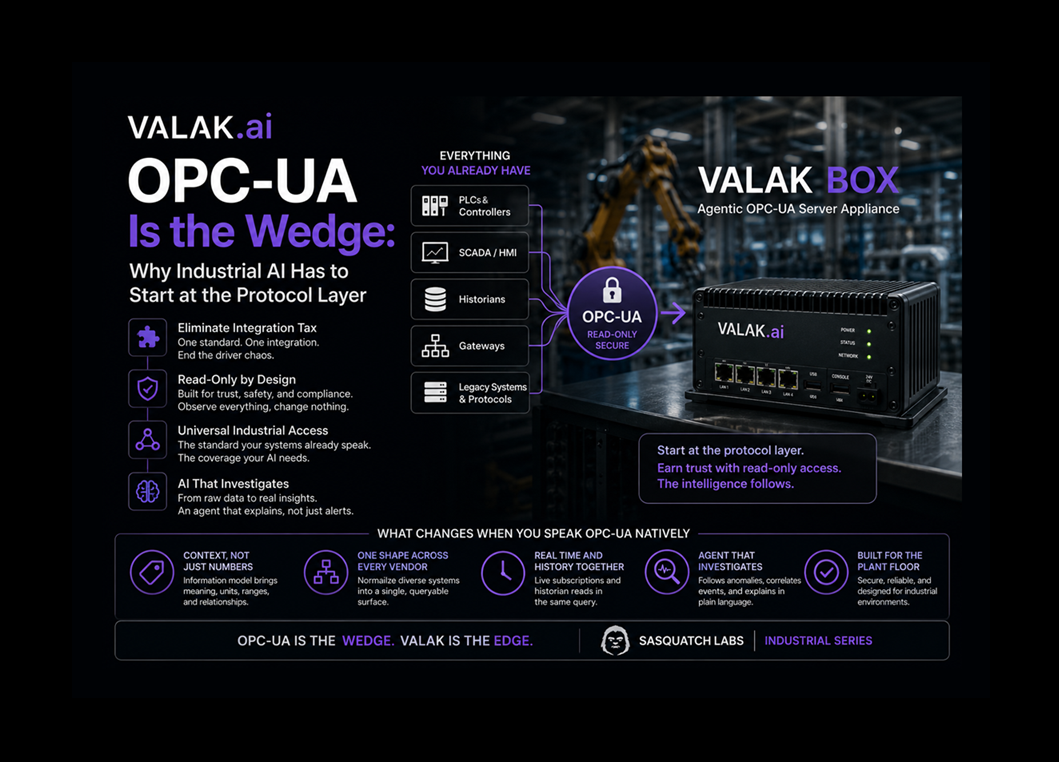
Every industrial AI pitch opens with the model. But on the plant floor, the model was never the hard part. The hard part is getting clean, complete, real-time access to what your machines already produce. That access problem has a name and a standard, and it is the reason we built Valak at the protocol layer first: OPC-UA.
The integration tax nobody budgets for
A modern plant is a museum of protocols. Modbus on a thirty-year-old PLC, EtherNet/IP on a newer line, a Wonderware or AVEVA historian over here, an Ignition gateway over there, a Siemens controller that speaks its own dialect. Every analytics or AI project that wants this data ends up rebuilding the same brittle connectors, one driver at a time. The proof-of-concept slips for a quarter, and most of that quarter is spent on plumbing, not intelligence.
This is the integration tax. It is paid in engineering months, and it is why so many “AI for manufacturing” initiatives stall before they ever touch a model.
Why OPC-UA is the universal read point
OPC-UA (Unified Architecture) is the one place nearly every serious industrial system already meets. SCADA platforms expose it. Historians expose it. PLCs and gateways expose it, or sit one hop away from something that does. It carries not just values but an information model: types, units, engineering ranges, and the relationships between tags. It is secure by design, vendor-neutral, and already deployed across the installed base.
If you want one integration that reaches the widest possible footprint of industrial equipment, OPC-UA is it. You do not have to convince a customer to rip and replace anything. You connect to the server they already run.
Read-only is a feature, not a limitation
Valak speaks OPC-UA read-only, always. That is a deliberate design decision, not a missing feature. The fastest way to get told “no” by an operations team is to ask for write access to a live control system. Safety, liability, and regulatory exposure all point the same direction: an AI layer has no business issuing setpoints.
Read-only collapses the trust conversation. There is no path by which the intelligence layer can move a valve, trip a line, or corrupt a control loop. It observes. That makes Valak something a plant manager can actually say yes to, and it is why the wedge works.
What changes once the AI layer speaks OPC-UA natively
Once you are fluent in OPC-UA, the model stops being the bottleneck and starts being the easy part:
- Context, not just numbers. The information model travels with the data, so an agent knows that a tag is a bearing temperature in degrees Celsius with a normal range, not an anonymous float.
- Every tag, every plant, one shape. A single integration normalizes Schneider, AVEVA, Ignition, and the rest into one queryable surface.
- Real time and history together. Live subscriptions for what is happening now, historian reads for what happened before, in the same query.
- An agent that investigates. Instead of a dashboard a human has to stare at, an agent can follow an anomaly across tags, correlate it with a maintenance window, and explain it in plain language.
The wedge
Valak is the Sasquatch Labs Industrial Series, and the flagship is the Valak Box: an agentic OPC-UA server appliance that drops into a plant, reads what is already there, and turns it into an AI-native, losslessly captured surface. Start at the protocol layer, earn trust with read-only access, and the intelligence follows. Everything else in industrial AI is downstream of solving the access problem first.