

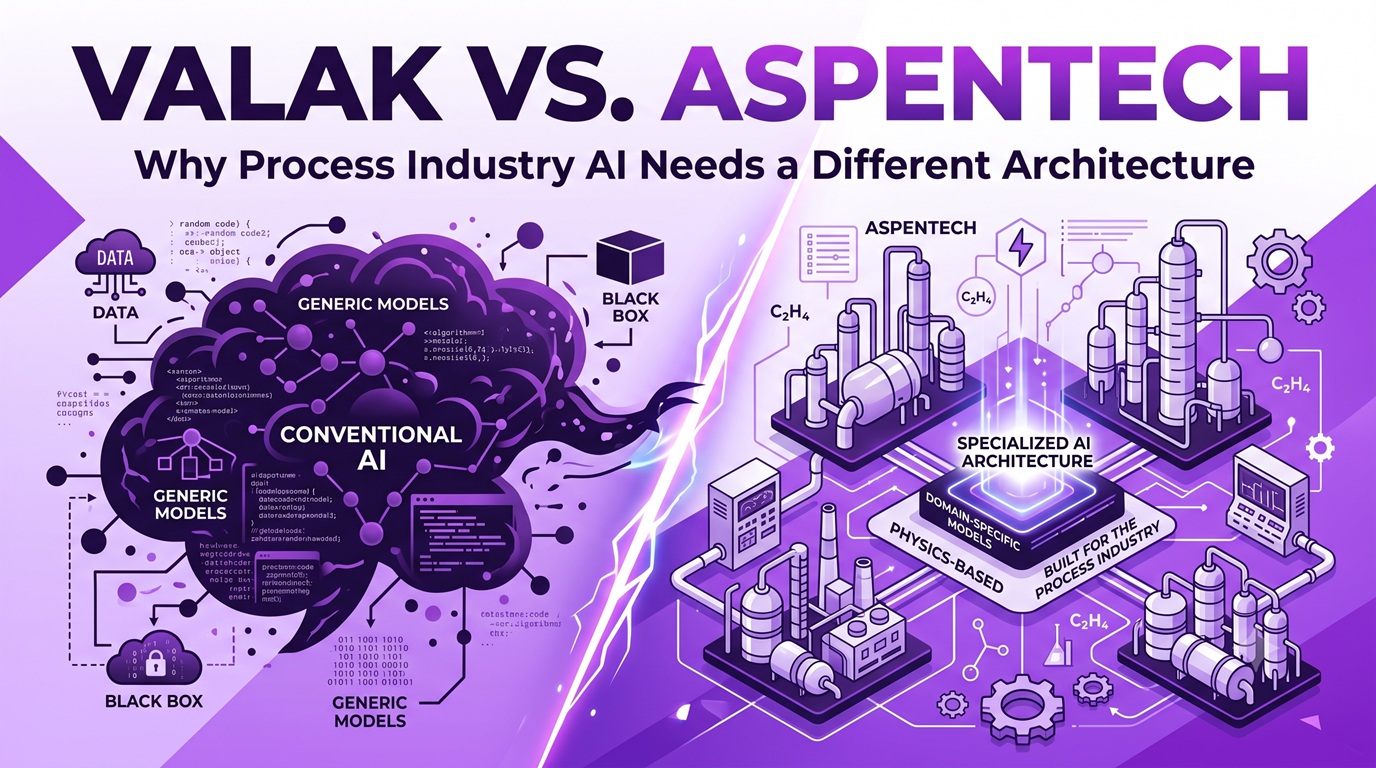
AspenTech — now fully part of Emerson — is one of the most capable industrial AI portfolios in the world for the engineer building a reliability program. It is not built for the operator standing next to the equipment at 2 a.m. who needs an answer right now. That gap is where Valak operates, and understanding it starts with being honest about what each product was actually designed to do.
- The quick answer
- What AspenTech is — and the Emerson acquisition context
- Aspen Mtell in 2026: what it actually does
- The Emerson Industrial AI Platform: the broader picture
- What Valak is and how it relates to AspenTech
- The core difference: prediction engine vs. conversational access layer
- The user gap: reliability engineers vs. everyone on the floor
- Side-by-side comparison
- When AspenTech is the right choice
- When Valak fills the gap
- Running both together
- The bottom line
- Frequently asked questions
The Quick Answer
AspenTech and Valak are not competing for the same job. AspenTech — specifically Aspen Mtell — builds AI models that predict equipment failures weeks or months before they occur, using machine learning trained on historical sensor data. It is a prediction engine built for reliability engineers and maintenance planners in oil and gas, chemicals, refining, and process manufacturing. It is genuinely excellent at what it does.
Valak is a conversational access layer. It gives any operator — regardless of experience, regardless of whether they know what Aspen Mtell is — the ability to ask a direct question about current or historical plant data and get a direct answer in plain language or by voice, right now, inside the plant’s own network. It does not build predictive models. It does not replace a reliability program. It fills the gap that even a fully deployed AspenTech environment leaves open: the gap between the AI that the engineer uses and the data that every other person on the floor needs access to.
Understanding why those are different problems — and why the same organization might genuinely need both — is the point of this article.
What AspenTech Is — and the Emerson Acquisition Context
AspenTech has been a significant force in industrial software for process industries for more than four decades. Its portfolio spans process simulation (Aspen HYSYS, Aspen Plus), production planning and scheduling (Aspen PIMS), and asset performance management — with Aspen Mtell as its flagship AI-driven predictive and prescriptive maintenance product.
Emerson completed the acquisition of all remaining outstanding shares of AspenTech on March 12, 2025, making AspenTech a wholly owned subsidiary of Emerson. The transaction valued the minority stake at USD 7.2 billion and the total company at a fully diluted market capitalization of USD 17 billion. AspenTech now reports to Emerson’s Control Systems and Software leadership and its results are consolidated into that segment. The acquisition brings AspenTech’s software portfolio together with Emerson’s DeltaV control systems, Plantweb digital ecosystem, and Ovation process control platform — creating one of the most comprehensive process industry automation and software stacks in the world.
For organizations evaluating AspenTech in 2026, this corporate context matters. AspenTech is no longer an independent software company — it is part of a larger automation ecosystem that includes Emerson’s own control systems, digital twin platforms, and Industrial AI Platform. An AspenTech deployment is increasingly an entry point into a broader Emerson software relationship, not a standalone product purchase. That is not a criticism — the integration between AspenTech’s optimization and reliability software and Emerson’s broader automation portfolio is a genuine value proposition for large process industry customers. It is simply important context for procurement decisions.
AspenTech has been serving the process industries for over forty years. Its customer base includes some of the largest oil and gas companies, chemical manufacturers, and refiners in the world. Aspen Mtell’s failure prediction — detecting equipment degradation signatures up to 90 days in advance — is documented in real deployments, not just marketing claims. The Emerson-Aramco deployment announced in April 2026 aimed specifically at refinery yield volume improvement illustrates the scale at which AspenTech operates. This is a serious, well-resourced, deeply experienced competitor in the industrial AI space, and any comparison that pretends otherwise is not credible.
Aspen Mtell in 2026: What It Actually Does
Aspen Mtell is AspenTech’s AI-driven predictive and prescriptive maintenance platform. It analyzes historical and real-time operational and maintenance data to discover the precise failure signatures that precede asset degradation and breakdowns, predict future failures, and prescribe detailed actions to mitigate problems.
The January 2026 release — part of the broader AspenTech V15 update — brought several meaningful enhancements that are worth understanding specifically:
- Rapid scalability via industry-specific asset templates. Industry and asset-specific templates and market-leading analytics drive faster deployment of asset health monitoring across the enterprise, enabling quick ROI and seamless transition to AI-driven prediction. Pre-populated templates for specific equipment types — compressors, pumps, turbines, heat exchangers — reduce the time and expertise required to deploy Mtell agents for new assets.
- Failure prediction up to 90 days in advance. Aspen Mtell uses data-driven predictive maintenance technology to deliver the earliest, most accurate warning of equipment failures, with the ability to detect failure patterns up to 90 days in advance. This is the core value proposition: lead time for maintenance planning rather than reactive response to failures.
- AI-powered alert grouping and prioritization. AI-powered insights automatically group and prioritize alerts based on severity. This directly addresses alert fatigue — one of the same problems that alarm management AI addresses in SCADA environments.
- Prescriptive recommendations, not just alerts. Aspen Mtell does not just flag that something is wrong — it recommends specific maintenance actions. This is the distinction between predictive maintenance (what will fail) and prescriptive maintenance (what to do about it).
Aspen Mtell seamlessly integrates with existing Enterprise Asset Management systems and other AspenTech products like Aspen Inmation, Aspen Fidelis, and Aspen HYSYS, ensuring a smooth transition and elevated user experience. Pre-populated asset templates allow for rapid deployment, enabling organizations to expand their maintenance strategies efficiently.
This integration picture is important. Aspen Mtell is not a standalone product — it is most valuable as part of an ecosystem that includes Aspen Inmation for data connectivity, Aspen Fidelis for reliability analysis, and the broader AspenTech process optimization suite. Deploying Mtell in isolation, without the surrounding AspenTech ecosystem, delivers some value but substantially less than the integrated picture.
The Emerson Industrial AI Platform: The Broader Picture
In May 2025, Emerson announced it is empowering manufacturers across every industry to drive toward optimized autonomous operations with the most advanced industrial artificial intelligence and data solutions for online, mission-critical applications. The May 2026 launch of the Emerson Industrial AI Platform extended this further — positioning Emerson as a provider of enterprise-scale AI that spans control systems, process simulation, predictive maintenance, and production optimization within a single ecosystem.
The Emerson Industrial AI Platform includes capabilities across the full AspenTech software stack — optimization, planning, simulation, and Mtell’s reliability AI — integrated with Emerson’s DeltaV control systems and digital infrastructure. It is an ambitious, comprehensive vision for what an AI-native process industry automation stack looks like.
It is also, by architecture and by design, a cloud-connected platform. Emerson’s announced Industrial Data Fabric — described in May 2026 as providing the foundation for a highly integrated industrial data platform — is built on the premise that operational data flows through Emerson’s connected infrastructure. For process industry organizations whose OT security posture permits that connectivity, the integrated Emerson/AspenTech ecosystem is a genuinely compelling offering. For organizations where it does not, the architecture question becomes the deciding factor, regardless of capability.
What Valak Is and How It Relates to AspenTech
Valak, built by Sasquatch Labs, is an agentic AI layer for HMI and SCADA systems — a conversational intelligence interface that sits on top of the plant’s existing data infrastructure and allows any user to ask questions about operational data in plain language or by voice.
The architectural difference from AspenTech’s approach is fundamental. AspenTech trains machine learning models on historical sensor data to identify failure signatures and predict future events. This is a model-building process that requires data scientists or reliability engineers to set up, configure, and maintain the agents. The output is an alert — “this asset will fail in approximately 23 days, here is the recommended action” — delivered to the reliability team.
Valak does not build predictive models. It retrieves and presents data in response to natural-language questions. When a maintenance supervisor asks “has the bearing temperature on Compressor 4 been trending the way it did before the failure in November,” Valak queries the historian, retrieves the relevant trend data, and answers directly. No model training. No agent configuration. No reliability engineering prerequisite. The question is answered from the actual historical record, by any user who thinks to ask it.
Both approaches have value. They address different aspects of the same underlying challenge: getting operational insight from plant data to the people who need it, fast enough to make a difference.
The Core Difference: Prediction Engine vs. Conversational Access Layer
The cleanest way to understand the difference between what AspenTech and Valak do is through the lens of who initiates the intelligence and when.
Aspen Mtell is proactive and model-driven. The AI is continuously monitoring sensor data against learned failure signatures and pushes an alert when it detects a pattern that precedes a known failure mode. The human does not need to ask — the system surfaces the insight. The limitation is that the system can only surface what the models were trained to look for. If a failure mode has not been seen before and trained on, Mtell cannot predict it. If an operator has a question about something that falls outside the trained model scope — a process deviation, a quality anomaly, a historical pattern they noticed — Mtell does not have an answer.
Valak is reactive and query-driven. The intelligence is activated when a human asks a question. The system retrieves what is relevant to that specific question from the actual operational record, not from a pre-trained model. The advantage is breadth: any question that can be answered from the historian or SCADA data can be asked. The limitation is that Valak does not proactively surface insights the operator did not know to ask about — it answers questions, it does not generate unsolicited alerts.
Aspen Mtell tells the reliability engineer what is going to fail before the operator has noticed anything wrong. Valak tells any operator what the historical data says when they notice something and want to understand it. Mtell surfaces known patterns from models. Valak retrieves raw truth from records. Together they close the data intelligence loop — before and after the event, for specialists and for generalists alike.
The User Gap: Reliability Engineers vs. Everyone on the Floor
The user population that benefits from each product is genuinely different, and this difference is not a matter of preference — it reflects the fundamental design philosophy of each system.
Aspen Mtell is built for reliability engineers, maintenance planners, and data scientists. Configuring a Mtell agent requires sensor mapping, failure mode identification, historical data review, and agent training — work that requires domain expertise and technical familiarity with the platform. The output — a prioritized alert with a prescriptive recommendation — is designed for the maintenance team to act on. It is a specialist-to-specialist intelligence product: experts build the models, experts respond to the alerts.
AspenTech’s AI capabilities include machine learning anomaly detection on sensor data predicting equipment failures weeks in advance, AI-powered production scheduling that optimizes refinery and chemical plant operations, and digital twin simulations that model process unit behavior under different operating conditions. These are engineering-grade capabilities requiring engineering-grade users to deploy and interpret them meaningfully.
Valak is designed for the operator who has never opened a historian client and does not need to. The shift supervisor making rounds. The maintenance technician at the equipment with both hands occupied. The new operator who does not yet know where anything lives in the tag structure. For these users, Aspen Mtell is not a tool they can access — it requires expertise they do not have and time they do not have. Valak asks nothing of them except the ability to ask a question in plain language.
This user gap is the same gap that appeared in the Valak vs. Seeq comparison — and it matters for the same reason: the people with the most valuable real-time situational awareness of the plant (the operators at the equipment) are structurally excluded from the AI tools that require specialist training to use. Valak’s core value proposition is closing that gap regardless of which other AI systems are running in the same environment.
Side-by-Side Comparison
| Dimension | Valak | AspenTech / Aspen Mtell |
|---|---|---|
| Core function | Agentic natural-language and voice query layer for SCADA/HMI/historian data | AI-driven predictive and prescriptive maintenance — failure prediction and asset performance management |
| AI model type | Agentic retrieval reasoning — answers questions from live and historical data | Machine learning failure signature models — trained on historical sensor data for each asset |
| Who initiates intelligence | Human operator asks a question — system retrieves and answers | System monitors continuously and pushes alerts when failure patterns are detected |
| Primary users | Any plant-floor user — operators, technicians, supervisors, managers | Reliability engineers, maintenance planners, data scientists |
| Deployment model | Air-gapped, on-premises — no cloud connectivity required for any function | Cloud-connected platform as primary architecture; Emerson Industrial Data Fabric for connectivity |
| Data source support | OPC UA, AVEVA PI, GE Proficy — native protocol connections | Aspen Inmation for data connectivity; integrates with EAM systems and AspenTech product suite |
| Setup requirement | Connect to existing OPC UA/historian — no model training required before use | Agent configuration, sensor mapping, failure mode definition, model training per asset |
| Failure prediction lead time | Not a predictive model — retrieves current and historical data for human assessment | Up to 90 days advance warning of equipment failure with prescriptive recommendations |
| Voice query | Supported — natural language and voice, designed for plant-floor use | Not a primary interface modality — alert delivery and dashboard review |
| Primary industries | Any industry running HMI/SCADA/historian — including oil and gas, chemicals, utilities, manufacturing | Oil and gas, chemicals, refining, metals and mining, pharmaceuticals, energy |
| Corporate ownership | Sasquatch Labs | Emerson (wholly owned subsidiary since March 2025) |
| Best fit | Operator-facing conversational data access, air-gapped OT environments, knowledge transfer | Engineer-led reliability programs, prescriptive maintenance at scale, process optimization |
When AspenTech Is the Right Choice
- You have a dedicated reliability engineering team that can configure, train, and maintain Mtell agents for each asset class. The platform’s value scales with the expertise applied to it — a well-configured Mtell deployment producing 90-day failure prediction with prescriptive recommendations is a genuinely powerful reliability program.
- You are already in the Emerson ecosystem or are willing to enter it. AspenTech’s value is maximized when used as part of the broader Emerson automation and software stack — DeltaV, Aspen Inmation, and the wider process simulation suite. Purchasing Mtell in isolation delivers less than the integrated picture.
- Your primary AI goal is proactive failure prediction at scale. No tool in the market delivers the combination of Mtell’s failure prediction lead time, the prescriptive maintenance recommendation engine, and the pre-populated industry-specific asset templates that accelerate deployment. For organizations building a systematic reliability program around AI, this is the category leader.
- Your cloud connectivity posture permits Emerson’s platform architecture. The Emerson Industrial AI Platform is cloud-connected by design. For organizations whose OT security policy allows that connectivity under appropriate controls, the integrated Emerson ecosystem delivers capabilities that on-premises-only tools cannot match in scope.
- You are in oil and gas, refining, or chemicals and have complex process simulation needs beyond predictive maintenance. Aspen HYSYS, Aspen Plus, and the process optimization suite have no direct equivalent in the Valak product family — they address a different and deeper layer of process engineering capability.
When Valak Fills the Gap
- Your operators — not just your reliability engineers — need data access. If the current state is that operators cannot access historian data without calling the engineer who knows the tag structure, Valak closes that gap directly. AspenTech’s product family does not address operator-facing conversational data access.
- Air-gapped deployment is a requirement. In oil and gas, chemicals, and refining environments with strict OT security constraints, the Emerson Industrial AI Platform’s cloud connectivity requirement may not be acceptable under the organization’s security policy or regulatory framework. Valak’s fully on-premises architecture operates without any external network connection.
- You need immediate value without a model training period. Aspen Mtell requires historical data collection, failure mode identification, and agent training before it can predict anything. Valak connects to existing OPC UA and historian infrastructure and is queryable immediately — any operator can ask a question from day one.
- Voice access matters for your environment. Field operators and maintenance technicians working in noisy, hands-busy environments in process facilities benefit from voice query in ways that a dashboard-and-alert model does not accommodate. Valak’s voice interface extends data access to users and contexts that AspenTech’s interface model does not serve.
- Knowledge transfer is an urgent priority. In oil and gas and chemicals facilities facing significant workforce retirement — the same Silver Tsunami affecting water utilities and manufacturing — Valak’s ability to give new operators conversational access to the plant’s historical data record is a direct operational continuity tool that a predictive maintenance platform does not provide.
Running Both Together
For process industry organizations with sufficient scale and budget, running both AspenTech and Valak is not only possible — it is the most complete answer to the full data intelligence challenge.
Aspen Mtell handles the proactive, model-driven reliability layer: continuously monitoring assets, detecting failure signatures up to 90 days in advance, and generating prescriptive recommendations for the maintenance and reliability engineering team. It answers the question “what is going to fail” before any human has noticed anything wrong.
Valak handles the reactive, conversational access layer: answering any question any operator asks about current or historical plant data, in plain language or by voice, from the equipment or from the control room, without requiring historian expertise or model training. It answers the question “what is happening right now” and “has this happened before” for every person on the floor who needs to know.
Both can connect to the same underlying historian infrastructure — AVEVA PI, GE Proficy, OPC UA — and neither replaces the other. The prescriptive maintenance alerts from Mtell go to the reliability engineers who act on them. The conversational queries from Valak go to the operators and technicians who act on their own situational awareness. The data flows are parallel, not competing.
- What Is Valak.ai? The Agentic AI Layer for HMI and SCADA
- Valak vs. AVEVA AI Assistant: Which Industrial AI Fits Your Plant?
- Valak vs. Seeq: Two Different Philosophies for Industrial AI
- Valak vs. Ignition SCADA: When a Platform’s AI Roadmap Is Not Enough Right Now
- Why Lossless Data Fidelity Is the Most Important Feature Nobody Is Talking About
- OT Cybersecurity in 2026: Why Air-Gapped AI Is Non-Negotiable
The Bottom Line
AspenTech — now operating as part of Emerson — is one of the most capable and credible players in process industry AI. Aspen Mtell’s failure prediction, prescriptive recommendations, and the broader Emerson Industrial AI Platform represent decades of domain expertise applied to one of the hardest problems in process manufacturing: knowing what is going to fail before it does, and knowing what to do about it. For organizations building serious reliability programs in oil and gas, chemicals, or refining, this is the right tool for that specific job.
Valak exists for a different job — the one AspenTech does not do. It gives every person on the plant floor, not just the reliability engineers, the ability to ask a direct question about plant data and get a direct answer. It does this on-premises, air-gapped, without model training, without historian expertise, and without the connectivity requirements that the Emerson platform’s architecture depends on. For the organizations whose operators need data access and whose security posture cannot accommodate cloud connectivity, Valak addresses the gap that even a fully deployed AspenTech environment leaves open.
Choose AspenTech / Aspen Mtell if…
You have a dedicated reliability engineering team, are building a systematic prescriptive maintenance program, are already in or willing to enter the Emerson ecosystem, your cloud connectivity posture permits the platform architecture, and your primary AI goal is proactive failure prediction with up to 90 days lead time and prescriptive recommendations at scale.
Choose Valak if…
Your operators — not just engineers — need conversational access to plant data, air-gapped on-premises deployment is required, you need immediate query value without a model training period, voice access matters for your environment, or knowledge transfer to a newer workforce is an urgent operational continuity priority.
Frequently Asked Questions: Valak vs. AspenTech
1. What is Aspen Mtell and what does it do?
Aspen Mtell is AspenTech’s AI-driven predictive and prescriptive maintenance platform. It analyzes historical and real-time operational and maintenance data to identify the specific failure signatures that precede equipment degradation and breakdowns, predicts when failures will occur with up to 90 days advance warning, and prescribes specific maintenance actions to prevent them. The January 2026 release introduced rapid scalability via industry-specific asset templates, AI-powered alert grouping and prioritization, and tighter integration with the broader AspenTech product suite including Aspen Inmation and Aspen Fidelis.
2. Did Emerson acquire AspenTech?
Yes. Emerson completed the acquisition of all remaining outstanding shares of Aspen Technology on March 12, 2025, making AspenTech a wholly owned subsidiary. The transaction valued the minority stake being acquired at USD 7.2 billion and the total company at approximately USD 17 billion. AspenTech now reports to Emerson’s Control Systems and Software leadership. AspenTech continues to operate under its own brand name and its products remain available as AspenTech products, but they are now part of the broader Emerson industrial automation and software ecosystem.
3. Is AspenTech cloud-based or on-premises?
AspenTech supports both cloud and on-premises deployment options for its simulation and optimization software, but its AI-driven asset performance management and the broader Emerson Industrial AI Platform are primarily cloud-connected in architecture. The Emerson Industrial Data Fabric — announced in May 2026 as the foundation for a highly integrated industrial data platform — is designed for connected operations. Organizations requiring fully air-gapped, on-premises AI deployment where no operational data can leave the plant network will find the Emerson platform’s architecture is not a fit for that constraint. Valak’s fully on-premises architecture addresses that requirement.
4. How is Valak different from Aspen Mtell?
Aspen Mtell is a model-building predictive maintenance platform: it trains machine learning agents on historical sensor data to detect failure signatures and proactively alerts maintenance teams to impending failures. Valak is a conversational query layer: it allows any operator to ask questions about current and historical plant data in plain language or by voice and receive direct answers from the actual operational record. Mtell tells experts what will fail before anyone notices it. Valak answers the questions any operator asks about what is happening right now or what happened in the past. They address different dimensions of the data intelligence challenge and can run on the same plant simultaneously.
5. Can Valak and AspenTech be used together?
Yes, and for process industry organizations with the scale to justify both, running them together provides the most complete data intelligence architecture. Aspen Mtell handles the proactive reliability layer — continuously monitoring assets and pushing prescriptive alerts to the maintenance and reliability team. Valak handles the conversational access layer — answering any question any operator asks about current or historical plant data in plain language or by voice. Both connect to the same underlying historian infrastructure. The prescriptive maintenance intelligence from Mtell goes to reliability engineers; the conversational query capability from Valak goes to everyone else on the floor.
6. What industries does AspenTech primarily serve?
AspenTech primarily serves capital-intensive process industries including oil and gas, chemicals, refining, metals and mining, pharmaceuticals, and energy. Its process simulation tools (Aspen HYSYS, Aspen Plus) are dominant in oil and gas and chemicals for engineering design and process optimization. Aspen Mtell serves these same industries for predictive maintenance. The Emerson acquisition has broadened the addressable market to include any industry running Emerson control systems, but the core AspenTech customer base remains concentrated in process industries.
7. How long does it take to deploy Aspen Mtell vs. Valak?
Aspen Mtell requires configuration before it can deliver value: sensor mapping, failure mode identification, historical data review, and agent training for each asset or asset class. The January 2026 update’s pre-populated industry-specific templates accelerate this process, but a full deployment across multiple asset classes in a complex process facility still requires months of engineering work. Valak connects to existing OPC UA and historian infrastructure and is queryable immediately after connection — any operator can ask a question on day one without any model training or configuration. The trade-off is that Valak does not proactively surface failure predictions; it answers the questions operators think to ask.
8. Does Aspen Mtell work with AVEVA PI or OPC UA?
Aspen Mtell connects to operational data primarily through Aspen Inmation, AspenTech’s data management platform, which itself integrates with various industrial data sources including OPC-compliant systems. For organizations running AVEVA PI historians, connecting to Mtell typically involves Aspen Inmation as the data connectivity layer. Valak connects natively to AVEVA PI, GE Proficy, and OPC UA using those systems’ existing protocols without an intermediate data connectivity platform as a prerequisite.
9. What is the Emerson Industrial AI Platform and how does it relate to AspenTech?
The Emerson Industrial AI Platform, announced in May 2026, is Emerson’s enterprise-scale AI offering for process industries. It brings together AspenTech’s optimization, reliability, and simulation software with Emerson’s DeltaV control systems, Plantweb digital ecosystem, and Emerson Industrial Data Fabric into a unified AI platform vision. It represents the strategic direction of the combined Emerson/AspenTech entity — a cloud-connected, enterprise-wide industrial AI and automation platform. For organizations purchasing AspenTech products in 2026, this broader platform context is relevant: AspenTech product decisions are increasingly decisions about entering the Emerson industrial software ecosystem.
10. Is Valak appropriate for oil and gas or chemicals facilities?
Yes. Oil and gas and chemicals facilities are primary Valak deployment targets for several reasons. The operator knowledge gap — experienced operators retiring faster than they can be replaced — is acute in these sectors. OT security requirements in many oil and gas and chemicals facilities are among the strictest in any industry, making air-gapped AI deployment particularly appropriate. Process historians (AVEVA PI and GE Proficy are dominant in these sectors) are exactly the data sources Valak connects to natively. And the physical plant environment — noisy, hands-busy, distributed across large facilities — is precisely where voice query provides its most significant accessibility benefit. Valak and AspenTech can serve the same facility simultaneously, addressing complementary use cases.
Add Conversational Data Access to Your Process Plant — Air-Gapped, On Day One
Valak connects to your AVEVA PI, GE Proficy, and OPC UA systems and gives every operator natural-language and voice query access to plant data — fully on-premises, no model training, no cloud connection required.