

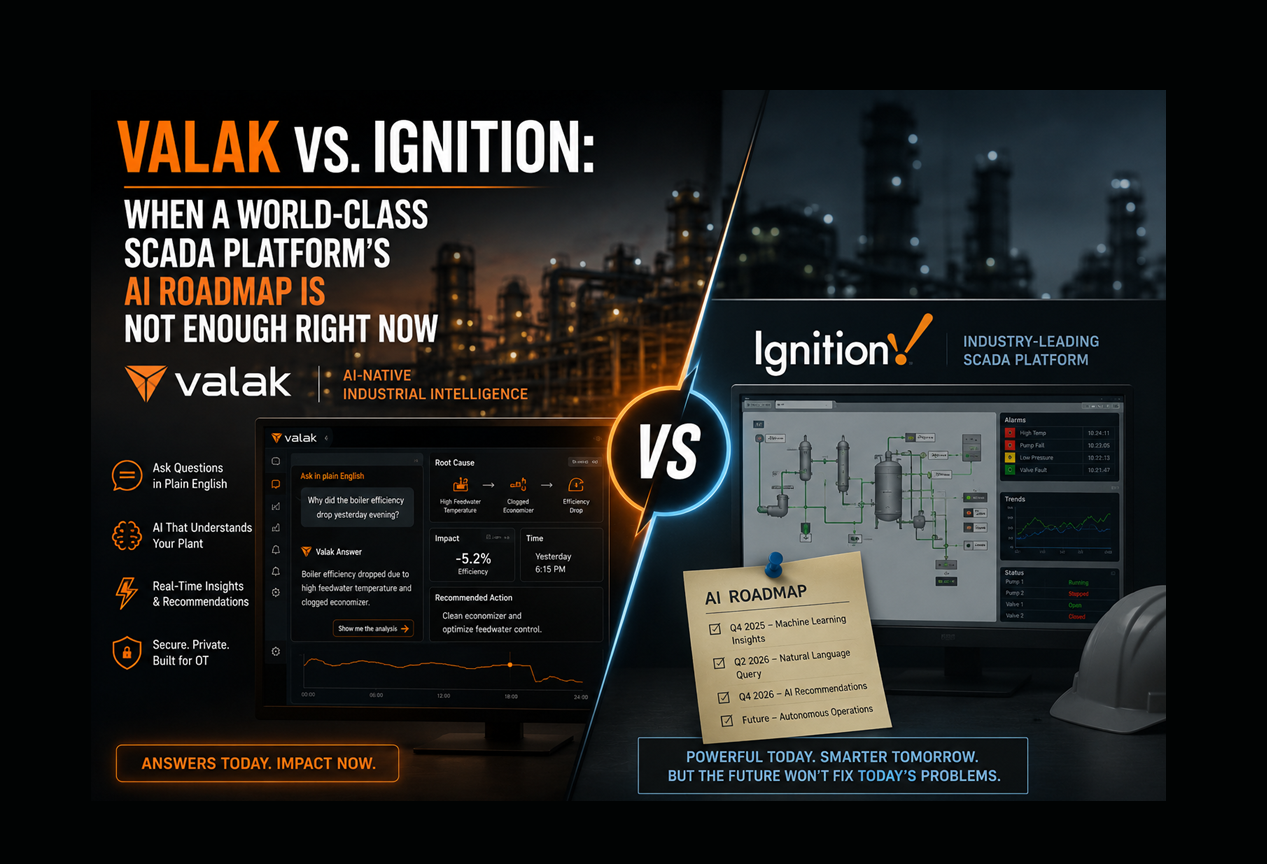
Ignition by Inductive Automation is one of the most widely deployed and genuinely well-loved SCADA platforms in the world. Its AI story in 2026 is real, credible, and still mostly future tense. Here is an honest look at where Ignition’s AI capabilities stand today, where they are heading, and when a dedicated agentic AI layer like Valak fills a gap that the platform itself does not yet close.
Industrial AI Comparison · Ignition SCADA · Inductive Automation · Agentic AI · SCADA/HMI · Sasquatch Labs Industrial Series · July 2026
- The quick answer
- What Ignition is — and why it matters to be honest about its strengths
- Ignition’s AI story in 2026: what exists today
- The MCP Module: real progress, real timeline uncertainty
- The system integrator dependency: what it means for operators
- What Valak is and how it relates to Ignition
- Why this is not a replacement comparison
- Side-by-side comparison
- When Ignition’s native AI approach is the right path
- When Valak fills the gap
- Running Valak on top of Ignition
- The bottom line
- Frequently asked questions
The Quick Answer
Ignition is a platform. Valak is an application. Those two words carry more weight in this comparison than any feature list, because they describe a fundamental architectural difference in how each product delivers value — and how much engineering work sits between purchase and a frontline operator getting a direct answer from their plant data.
Ignition gives you the infrastructure to build almost anything: SCADA screens, MES workflows, historian integrations, reporting, alarming, and increasingly, AI-connected workflows via its forthcoming MCP Module. What it does not give you, out of the box in 2026, is a natural-language or voice query interface that any operator can walk up to and ask “what happened on Line 3 last night.” That capability either requires a system integrator to build it on top of Ignition’s architecture, or a third-party AI module bolted onto the platform — both of which involve time, cost, and ongoing customization that most plants do not have the resources to sustain.
Valak is a purpose-built agentic AI layer designed to close exactly that gap — the gap between the data Ignition collects and the ability of any operator, not just engineers and SI-trained specialists, to ask a direct question of it. And it can do so on top of an existing Ignition installation, without replacing anything.
What Ignition Is — and Why It Matters to Be Honest About Its Strengths
Before making any comparison, intellectual honesty demands acknowledging what Ignition actually is, because it is a genuinely impressive and deservedly popular piece of industrial software.
Ignition’s unlimited tag licensing model is one of its most disruptive innovations — traditional SCADA platforms charge per I/O point with costs escalating dramatically as systems grow, while Ignition charges per server regardless of tag count, reducing total cost of ownership by 40 to 60% compared to traditional platforms for medium to large installations. That pricing model alone has made Ignition the platform of choice for a generation of system integrators who were tired of watching projects get descoped because the tag count exceeded the budget.
Inductive Automation has 5,000-plus integrators in its integrator program, installations in 140-plus countries, and 69% of the Fortune 100 use Ignition. Those numbers are not marketing inflation — they reflect a platform that has earned genuine trust across industries ranging from pharmaceutical manufacturing and water treatment to food and beverage, oil and gas, and defense. Ignition’s Perspective module delivers web-based HMI to any browser on any device. Its historian — rebuilt in version 8.3 with QuestDB powering a Core Historian capable of up to 2 million data points per second — is genuinely competitive with dedicated historian platforms for most mid-market applications. Its OPC UA support is solid and standard.
All of that context matters because this comparison is not a story about a bad platform versus a good one. It is a story about what a platform-first architecture means for AI capability delivery timelines, and what a purpose-built application can do in the gap while the platform’s AI roadmap matures.
Ignition has one of the most active and genuinely helpful communities in industrial automation. The Ignition Community Forum, the annual Ignition Community Conference, and the Inductive University training program represent a level of ecosystem investment that most industrial software vendors do not match. Any evaluation of Ignition should include the ecosystem value — the availability of 5,000-plus trained integrators and a community of thousands of practitioners who have solved most problems someone new to the platform will encounter.
Ignition’s AI Story in 2026: What Exists Today
To understand where Ignition’s AI capability stands in mid-2026, it helps to understand the architecture it is starting from and the path it is taking.
Ignition’s platform is built on open, IT-standard technologies — Python scripting, SQL databases, OPC UA, MQTT/Sparkplug B, and a modular architecture that allows third-party capabilities to be added through certified modules. This openness is one of Ignition’s greatest strengths generally, and it means that AI capabilities can be integrated into Ignition environments in several ways today:
Python scripting and third-party ML libraries
Ignition offers open, flexible architecture for connecting AI models and advanced analytics platforms — including Tag Historian for capturing high-resolution time-series data for AI training, scripting and APIs for seamless integration with Python, machine learning libraries, and cloud AI tools, and edge computing for local decision-making on machines and PLCs. A skilled system integrator can write Python scripts within Ignition that call ML models, connect to external AI APIs, or implement custom analytics logic. This works, and organizations with the right SI relationships and engineering resources have done impressive things with it. But it is custom development work — not a product someone deploys and uses on day one.
Third-party AI modules from the Ignition ecosystem
Products like SORBA.ai have built direct Ignition integrations — SORBA IoT-Unified Version 10.7, released in April 2026, delivers 100% integration and model-building capability within Inductive Automation’s Ignition SCADA 8.3, including an expanded AI model library and a fully guided asset creation workflow. These integrations are real and functional for ML model deployment and analytics workflows. They are oriented toward data engineers and ML practitioners building and deploying models — not toward frontline operators asking questions in plain language.
Community MCP server implementations
The open-source community has built MCP server implementations for Ignition — one published on PyPI provides AI assistants with access to an Ignition gateway, supporting tag browsing, history queries, alarm queries, project management, and Perspective view deployment across 43 tools. This is technically impressive community work. It is also a developer tool — it requires an MCP client (like Claude Desktop), technical configuration, and an understanding of Ignition’s architecture to use meaningfully. It is not a natural-language interface that an operator in a hard hat can walk up to and use without training.
The MCP Module: Real Progress, Real Timeline Uncertainty
The most significant AI-related announcement from Inductive Automation in 2025 was the unveiling of a native MCP Module for Ignition at the September 2025 Ignition Community Conference. The module is positioned as the official way to connect Ignition’s data and capabilities to AI systems through the Model Context Protocol — the same open standard that allows AI assistants to interact with external tools and data sources.
The Ignition MCP Module entered Early Access in February 2026 on a nightly build of the platform, requiring Ignition 8.3.5 or later to run. As of Ignition’s June 2026 release notes, the MCP Module was not included in the 8.3.5 general availability release, prompting questions from the community about the updated target release. The forum thread for the Early Access program includes requests for an updated timeline, with one community member asking: “Now that 8.3.5 has shipped without the MCP module, can anyone from IA give an updated target release? Is 8.3.6 the current plan, or has the timeline shifted further out?” Inductive Automation confirmed the module is planned for release in 2026 as part of the Enterprise Integration Solution Suite. Organizations that need this capability now should verify current release status directly with Inductive Automation.
What the MCP Module is designed to do, when it ships, is allow AI systems to connect to Ignition’s scripting engine and access the system capabilities and data that can be reached through that engine — tag reads, historian queries, alarm data, project management, and more. Inductive Automation describes the MCP Module as enabling AI to connect to Ignition systems and make it the best platform for creating MCP servers, exposing all the system capabilities and information accessible via Ignition’s scripting engine to AI systems.
That is a meaningful capability — and it is oriented, as the description suggests, toward making Ignition the best platform for system integrators and developers to build AI-connected industrial applications. It is a developer tool and an integration standard. It is not, by itself, a natural-language or voice query interface for frontline operators. What an operator would experience through the MCP Module depends entirely on what application is built on top of it — which brings us back to the system integrator dependency.
The Ignition MCP Module is to agentic AI what a SQL database is to a business application: it is an infrastructure layer that makes certain things possible. Whether those things actually get built — and built well, and maintained over time — depends on what sits on top of it. Valak is the application layer. It is what sits on top of the protocol and data infrastructure and delivers a complete, usable experience to the operator without requiring custom development.
The System Integrator Dependency: What It Means for Operators
This is the most important structural point in the comparison, and it deserves careful treatment because it reflects a genuine trade-off in Ignition’s platform model rather than a criticism of Ignition itself.
Ignition’s business model is built around a thriving ecosystem of system integrators — more than 5,000 companies globally who design, build, deploy, and maintain Ignition-based solutions for industrial organizations. This model has worked enormously well for Ignition’s growth and for the breadth of applications the platform supports. It is also the model that means most AI capabilities on Ignition, in 2026, require SI engagement to deliver.
An organization that wants natural-language query of their Ignition historian data today has several paths, none of which is “install a module and use it”:
- Engage a system integrator to build a custom solution using Ignition’s Python scripting, connecting to an external LLM API, and building a query interface — a custom development project with custom development timelines and costs.
- Integrate a third-party analytics module like SORBA.ai’s platform — which requires its own licensing, deployment, and training investment, and is oriented toward ML model workflows rather than operator-facing natural-language query.
- Use the community MCP server for Ignition — which requires developer-level configuration and an MCP client, and delivers a developer tool rather than an operator interface.
- Wait for the official MCP Module and then engage an SI to build an operator-facing application on top of it — which compounds the timeline question with the development lead time question.
Each of these paths has legitimate use cases. None of them is the answer to “I want my operators to be able to ask plain-language questions of our Ignition historian data next month.” The SI dependency means that the gap between Ignition’s platform capability and a deployed, usable operator experience is measured in months and SI hours, not days and license keys.
What Valak Is and How It Relates to Ignition
Valak, built by Sasquatch Labs, is an agentic AI layer for HMI and SCADA systems. It is not a SCADA platform — it does not replace Ignition’s historian, its tag management, its alarm system, or any other part of the platform’s core functionality. It connects to Ignition’s OPC UA server and historian data, sits on top of that existing infrastructure, and provides natural-language and voice query access to any authorized user without requiring historian expertise, custom scripting, or SI engagement to deploy the operator experience.
In an Ignition environment specifically, Valak connects via OPC UA — the standard protocol that Ignition’s gateway exposes natively — and can query tag history from the Ignition historian through that interface. The operator interaction is the same as in any other Valak-supported environment: ask a question by typing or speaking, get a direct answer from the plant data, with no requirement to know the tag naming convention or navigate the Ignition designer.
Valak’s air-gapped, on-premises deployment model is directly relevant to Ignition environments. Ignition itself supports fully on-premises deployment — it is one of the platform’s strengths for organizations that cannot or do not want to send plant data to the cloud. A natural-language AI layer that also runs fully on-premises and requires no cloud connectivity for inference is architecturally consistent with that deployment model. An AI module that requires cloud connectivity for LLM inference would introduce the cloud dependency that Ignition’s on-premises deployment was specifically chosen to avoid.
Why This Is Not a Replacement Comparison
The previous comparison posts in this series — Valak vs. AVEVA and Valak vs. Seeq — involved products that overlap more directly in their core purpose. AVEVA’s AI Assistant and Seeq are both doing some version of what Valak does: connecting to industrial data and providing an intelligence interface on top of it. The comparison in those cases is between different implementations of a similar concept.
Ignition is categorically different. Ignition is the SCADA and HMI platform that Valak sits on top of. Comparing them as direct competitors would be like comparing a database to the application that queries it — they operate at different layers of the same stack. An organization does not choose between Ignition and Valak. An organization running Ignition asks whether they want to add Valak as the natural-language intelligence layer on top of their Ignition infrastructure — or whether they want to wait for Ignition’s platform AI capabilities to mature and then engage an SI to build that layer themselves.
The comparison in this article is therefore better understood as: Ignition’s AI roadmap versus Valak today. What can you do right now versus what will you be able to build eventually, and what does the gap cost in terms of time, SI engagement, and operator experience during the interim?
Side-by-Side Comparison
| Dimension | Valak | Ignition (AI capabilities, 2026) |
|---|---|---|
| Product type | Purpose-built agentic AI layer for SCADA/HMI — a deployable application | Industrial automation platform — foundation for building applications |
| Natural-language operator query | Available today — core product capability, no custom development required | Not natively available; requires SI custom development or third-party module |
| Voice query | Supported — voice and text input, designed for plant-floor use | Not natively available — requires custom implementation via scripting or SI build |
| MCP / AI connectivity | Agentic reasoning built into core architecture | MCP Module in Early Access February 2026 — developer/integrator tool, not yet GA |
| Deployment model | Air-gapped, on-premises — no cloud connectivity required for inference | Fully on-premises SCADA platform; AI extensions may introduce cloud dependencies depending on implementation |
| Data sources | OPC UA, AVEVA PI, GE Proficy — including Ignition’s OPC UA server | Native Ignition historian, OPC UA, MQTT/Sparkplug B, SQL databases, 300-plus drivers |
| Target AI user | Any plant-floor user — operators, maintenance, supervisors | AI tools currently oriented toward developers, SIs, and data engineers |
| Time to operator value | Deployable on existing OPC UA infrastructure — weeks not months | Depends on SI engagement and application development timeline — typically months |
| Data fidelity | Lossless — raw historian data queried directly, not summarized in transit | Depends on implementation — historian data is accurate; AI layer fidelity varies by third-party module |
| Licensing model | AI layer licensing | Server-based platform licensing plus module costs; Enterprise Integration Suite for MCP Module access |
| Best fit | Ignition operators who need natural-language data access today, without waiting for the platform’s AI roadmap | Organizations building complex, SI-customized industrial applications with long-term platform investment |
When Ignition’s Native AI Approach Is the Right Path
There are genuine circumstances where waiting for Ignition’s AI roadmap — or investing in SI-built AI capabilities on top of the platform — is the right decision.
- You have a long-term, deep SI relationship with a partner who knows your Ignition environment and has the capability to build and maintain a custom AI layer on top of it. In that case, the development investment can produce something tailored to your specific plant, tag structure, and operational workflows in a way that an out-of-the-box product cannot match.
- You are planning a major Ignition upgrade anyway and the MCP Module timeline aligns with your implementation window. If you are moving to Ignition 8.3 in the next six months and have engineering resources to build on top of the MCP Module once it ships, building the AI layer as part of that project makes architectural sense.
- Your primary AI use case is developer-oriented — building AI-assisted SCADA screens, automating project deployment, generating Perspective views from specifications — rather than giving frontline operators plain-language data access. The MCP Module in its current form is well-suited to developer and integrator workflows.
- You want deep ML and predictive analytics integration within the Ignition ecosystem. Third-party modules like SORBA.ai’s platform deliver ML model training and deployment within Ignition that goes beyond what a natural-language query layer provides. If your goal is building and maintaining ML models that run inside your SCADA environment, that ecosystem is more relevant than Valak.
When Valak Fills the Gap
- You need operator-facing natural-language query today, not when the MCP Module ships and not after an SI engagement to build a custom application on top of it. Valak deploys on existing OPC UA infrastructure and delivers an operator experience without a development project in between.
- You are running Ignition in an air-gapped environment and any AI capability needs to run within the same network boundary. Valak’s air-gapped architecture is consistent with Ignition’s on-premises deployment model. AI modules that require cloud connectivity for LLM inference would introduce a cloud dependency that an air-gapped Ignition deployment was specifically designed to avoid.
- You do not have an active SI relationship or the SI engagement budget to commission a custom AI application build. Valak’s value proposition is specifically that it delivers the operator experience without requiring custom development work.
- Your operators are the primary beneficiary — not your engineers or data scientists. Valak is designed for the frontline user who will never open Ignition Designer, never write a Python script, and needs to ask a data question in plain language at 2 a.m. without calling an engineer.
- You want to add AI now while your Ignition environment continues as-is, without timing the AI deployment to a platform upgrade cycle or a module release schedule.
Running Valak on Top of Ignition
This is the scenario that applies to many Ignition shops in 2026: Ignition runs the plant — historian, SCADA, HMI, alarming, MES workflows. Valak sits on top of Ignition’s OPC UA server as the natural-language and voice query interface for operators and plant managers who need to ask data questions without navigating Ignition directly.
The integration point is straightforward: Ignition exposes its tag data through an OPC UA server natively, and Valak connects to OPC UA as one of its primary data sources. Historian data accessible through Ignition’s historian module is queryable by Valak through this interface. No modification to the Ignition configuration is required beyond ensuring the OPC UA server is accessible within the plant network.
In this architecture, Ignition continues to do what it does best — industrial-grade SCADA with a 20-year track record, unlimited tag licensing, Perspective-based HMI, and a thriving SI ecosystem for customization. Valak adds what Ignition does not currently provide out of the box: a natural-language and voice interface that makes that data accessible to any plant-floor user, running entirely within the existing network boundary.
This is not a compromise architecture. It is a layered architecture that uses each product for what it was designed to do.
- What Is Valak.ai? The Agentic AI Layer for HMI and SCADA
- What Is Agentic AI for Industrial Control Systems? A Complete Guide
- Valak vs. AVEVA AI Assistant: Which Industrial AI Fits Your Plant?
- Valak vs. Seeq: Two Different Philosophies for Industrial AI
- OT Cybersecurity in 2026: Why Air-Gapped AI Is Non-Negotiable
The Bottom Line
Ignition is an excellent SCADA platform with a credible and actively developing AI roadmap. The MCP Module, when it ships in full release, will make it genuinely easier for system integrators to build AI-connected industrial applications on top of Ignition’s infrastructure. That is a meaningful step, and organizations making long-term platform investments in Ignition are right to factor it into their planning.
What it is not, in July 2026, is a deployable natural-language operator interface. The MCP Module is in Early Access and has slipped at least one planned release. The operator experience it enables depends on what application gets built on top of it, which requires SI engagement and custom development. The timeline from “MCP Module ships” to “our operators can ask plain-language questions of our Ignition data” is not days — it is months of SI work.
Valak exists for the gap between now and that future state. It deploys on existing Ignition OPC UA infrastructure, delivers natural-language and voice query to any operator today, runs air-gapped within the same network boundary Ignition was deployed in, and does not require an SI engagement to produce an operator-usable experience. For Ignition shops that need operator data access now — not when the platform’s AI roadmap matures — that gap is exactly what Valak was built to fill.
Stay with Ignition’s native AI path if…
You have a deep SI relationship, are planning a platform upgrade that aligns with the MCP Module timeline, your primary AI need is developer or ML-model-oriented rather than operator-facing, or you have the resources and patience for a custom build that will be highly tailored to your specific environment.
Add Valak if…
Your operators need plain-language data access now, you are running air-gapped and cannot introduce cloud dependencies, you do not have an active SI relationship or the budget for a custom build, or you want to layer agentic AI on top of your existing Ignition investment without waiting for a module release or commissioning a development project.
Frequently Asked Questions: Valak vs. Ignition
1. Does Ignition have native AI or natural-language query capabilities in 2026?
Not as a built-in, out-of-the-box operator interface in mid-2026. Ignition supports AI integration through its open Python scripting environment, APIs, and third-party certified modules — but natural-language query for frontline operators requires either custom SI development or a third-party module. Inductive Automation’s MCP Module, which would make it easier for AI systems to connect to Ignition data and capabilities, was in Early Access as of February 2026 and had not shipped in a general availability release as of the June 2026 platform update. Inductive Automation has confirmed the module is planned for 2026 as part of the Enterprise Integration Solution Suite.
2. What is the Ignition MCP Module and when will it be available?
The Ignition MCP Module is Inductive Automation’s implementation of the Model Context Protocol for the Ignition platform. It allows AI systems to connect to Ignition’s scripting engine and access the data and system capabilities available through that engine — tag reads, historian queries, alarm data, and more. It was announced at the Ignition Community Conference in September 2025, entered Early Access in February 2026 requiring a nightly build of Ignition 8.3.5, and had not shipped in a general availability release as of June 2026. Community forum discussions indicate the timeline may have shifted beyond 8.3.5, with 8.3.6 being discussed. Organizations should contact Inductive Automation directly for the current release target.
3. Can Valak work with an Ignition SCADA installation?
Yes. Valak connects to Ignition’s native OPC UA server, which Ignition exposes as a standard feature of the platform. Tag values and historian data accessible through that interface are queryable by Valak. No modification to the Ignition platform configuration is required beyond ensuring the OPC UA server is accessible within the plant network. Valak operates as an additional intelligence layer on top of the existing Ignition installation without replacing any of Ignition’s native functionality.
4. Is Ignition better than Valak for industrial AI?
The comparison is not well-formed because the products operate at different layers of the industrial software stack. Ignition is a SCADA and HMI platform — it collects data, runs control systems, manages alarms, and provides visualization. Valak is an agentic AI application layer that sits on top of SCADA and historian infrastructure and provides natural-language query access to that data. They are complementary rather than competing. The relevant question is whether Ignition’s platform-level AI roadmap will deliver an operator-facing natural-language query experience fast enough for your needs — and if not, whether adding Valak on top of Ignition fills that gap in the interim.
5. Does the Ignition MCP Module provide natural-language query for operators?
The MCP Module provides the infrastructure for AI systems to connect to Ignition data and capabilities through the Model Context Protocol. What operators experience as a result of that infrastructure depends on what application is built on top of it — which requires SI development work. The MCP Module itself is a developer and integrator tool, not a ready-made operator interface. An operator-facing natural-language query experience using the MCP Module would require an SI to build a client application, connect it to an LLM, and design the operator interaction layer — a development project separate from the module itself.
6. Is Ignition cloud-based or on-premises?
Ignition supports both fully on-premises deployment and a cloud edition. The core platform — SCADA, historian, HMI, alarming — can run entirely on-premises with no cloud connectivity required. Ignition Cloud Edition is a separate offering for organizations that want cloud-hosted deployment. AI capabilities added to Ignition through third-party modules or custom SI builds may introduce cloud dependencies depending on the implementation — for example, if the AI inference is handled by an external LLM API. Valak’s air-gapped architecture ensures that all AI inference happens within the plant network, maintaining consistency with an on-premises Ignition deployment and avoiding the introduction of cloud dependencies.
7. How many countries use Ignition SCADA?
Inductive Automation reports Ignition installations in more than 140 countries, with more than 5,000 companies in its integrator program. Sixty-nine percent of the Fortune 100 use Ignition. It is one of the most widely deployed SCADA platforms globally, particularly dominant in North America and growing strongly in international markets across manufacturing, utilities, water and wastewater, oil and gas, pharmaceutical, and food and beverage sectors.
8. What is the difference between Ignition Perspective and an agentic AI layer like Valak?
Ignition Perspective is a web-based HMI framework — it delivers SCADA visualization screens to browsers and mobile devices, showing pre-configured views of process data, alarms, and trends. An agentic AI layer like Valak answers questions that were not anticipated at design time. Perspective shows what the engineer configured it to show. Valak answers questions the engineer never had to anticipate — “has this behavior happened before,” “what changed in the last 12 hours,” “which assets are trending abnormally.” Both access plant data; the difference is between presenting pre-configured information and reasoning autonomously toward an answer to an ad hoc question.
9. Does Valak replace the need for an Ignition system integrator?
No. Valak replaces the need for SI custom development specifically for the natural-language operator query use case — it provides that capability as a deployable product rather than a build project. It does not replace SI expertise for Ignition platform configuration, screen development, historian setup, alarm management, MES workflows, or any other aspect of the Ignition implementation. Organizations running Ignition still benefit from their SI relationships for everything those SIs do well. Valak adds the one specific capability — agentic natural-language query — that current Ignition deployments do not provide out of the box.
10. Why is air-gapped deployment relevant for Ignition users specifically?
Ignition is frequently chosen by organizations that run on-premises for security, regulatory, or operational reasons — the platform’s on-premises deployment model is one of its appeals for critical infrastructure operators and regulated industries. When those organizations add AI capabilities, they face a risk of introducing cloud dependencies that their Ignition deployment was specifically chosen to avoid. An AI module that requires LLM inference through an external cloud API, or that sends historian data to a cloud platform for processing, effectively adds the cloud exposure that the on-premises Ignition deployment was meant to prevent. Valak’s air-gapped architecture maintains the network boundary that on-premises Ignition users have already established — all AI inference happens inside the plant network, with no data crossing the perimeter.
Add Natural-Language Query to Your Ignition Environment Today
Valak connects to Ignition’s OPC UA server and delivers plain-language and voice access to your plant data — on-premises, air-gapped, no SI build required, no cloud dependencies introduced.