

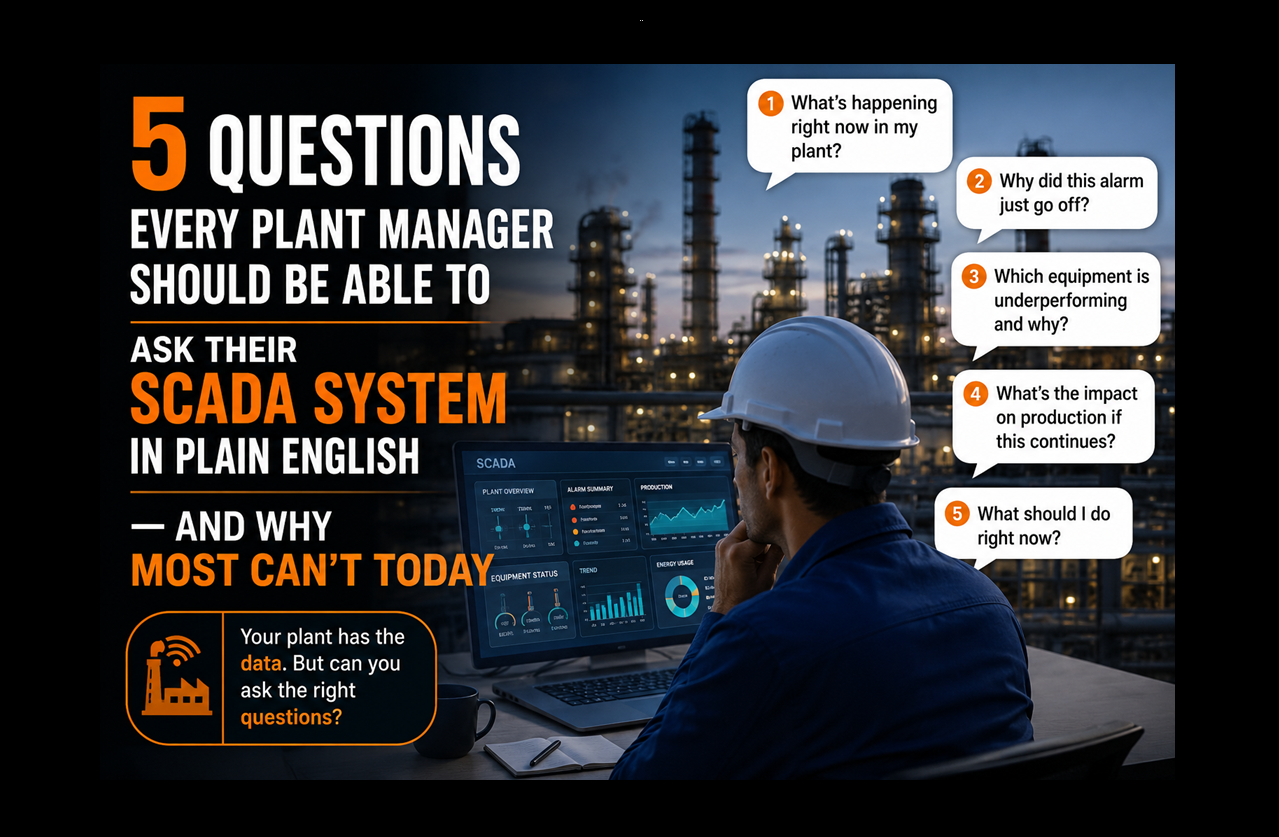
If your operational data cannot answer a direct question in the time it takes to lose an opportunity to act on it, the data is not an asset. It is an archive. Here is what real-time, plain-language access to your plant data should look like — and where the gap still lives for most operations teams in 2026.
Plant Management · SCADA · Operations Intelligence · Industrial AI · OEE · Sasquatch Labs Industrial Series · July 2026
- The gap between knowing and being able to ask
- Question 1: What actually caused last night’s downtime event?
- Question 2: Which of my assets are most likely to fail in the next 30 days?
- Question 3: Are we running at world-class efficiency right now, and if not, why not?
- Question 4: Has this process behavior happened before, and what followed it?
- Question 5: What changed on this line in the last 24 hours?
- The self-test: how does your plant score?
- What changes when you can actually ask these questions
- Frequently asked questions
The Gap Between Knowing and Being Able to Ask
There is a version of the plant manager’s job that looks, on paper, like it should be well-supported by data. Modern SCADA systems aggregate inputs from thousands of sensors. Historians store years of time-series records. HMI screens display real-time process values in color-coded graphics. The data is there. The infrastructure to collect, store, and display it has been invested in, maintained, and trusted for decades.
And yet a consistent finding across manufacturing, utilities, energy, and process industries in 2026 is that plant managers — the people most responsible for making high-stakes decisions about plant performance, maintenance scheduling, and operational priorities — are often the least able to ask direct, specific questions of all that data and get direct, specific answers in time to act on them.
Plant managers cannot see production status without walking to the control room. ERP planners set schedules without knowing which machines are degrading. Maintenance teams create work orders manually instead of receiving AI-generated recommendations. Finance cannot allocate energy costs to specific production orders in real time. These are not hypothetical gaps. They are the documented operational reality of the majority of industrial plants running today.
average annual production time lost to unplanned downtime in a typical manufacturing plant
higher OEE achieved by plants with real-time KPI visibility vs. those relying on periodic reporting, per Gartner
OEE range for most manufacturing facilities in 2026 vs. the 85%+ world-class target
how often most plant managers see KPI data — by which time the root cause is cold and the opportunity to act has passed
The five questions in this article are the questions every plant manager should be able to ask their SCADA or historian system in plain language — and get a direct, data-grounded answer in seconds, not hours. For each one, we look at why the question matters, what it typically takes to answer it today without conversational AI, and what changes when the barrier to asking it disappears.
This article is not about asking vague questions and getting generic answers. It is about asking specific operational questions — about specific assets, specific time windows, specific process variables — and getting specific data-grounded answers. The benchmark is not whether the AI sounds smart. It is whether the answer is correct, fast, and rooted in the actual operational record.
Question 1
“What actually caused last night’s downtime event on Line 3?”
Unplanned downtime is the single largest driver of OEE loss in most manufacturing environments. Every percentage point of OEE represents real production capacity — at larger facilities, each OEE point can represent USD 10 million or more in annual revenue. Understanding the root cause of a downtime event — not the symptom, not the downstream cascade, but the originating failure — is the difference between fixing the problem and repeating it next shift.
The challenge is that by the time a plant manager asks this question — typically at the morning meeting, reviewing the overnight shift report — the evidence is cooling. The engineer who was on shift when it happened has gone home. The alarm log shows forty-three events in a ninety-second window. The historian has the raw data, but someone needs to go find it, correlate it across systems, and reconstruct the sequence of events that preceded the trip.
In most plants today, that reconstruction takes hours. It requires someone who knows the tag structure, can navigate the historian client, understands which alarms were root-cause events versus downstream cascades, and has enough context about the unit to know what normal looks like before the deviation started. If that person is not available at 7 a.m., the question either goes unanswered or gets answered with incomplete information.
Root cause investigation becomes a specialist task scheduled for later in the day, by which time operators and maintenance staff have moved on to the current shift’s problems. The same failure mode recurs on the next shift or the next week, because the understanding of what caused it never made it into a corrective action while the data was fresh.
By the time you see that OEE dropped to 55% last Wednesday, the root cause is cold, the evidence is gone, and you are already fighting this week’s fires. That observation from a 2026 manufacturing KPI analysis is not a criticism of plant managers — it is a structural description of what happens when data access requires specialist mediation and specialist mediation takes time.
The question is asked at the morning meeting, answered in real time from the historian and alarm log, and the root cause — the first abnormal reading that preceded the cascade — is on the table before the meeting ends. The corrective action gets assigned the same morning, while the maintenance team that responded to the event overnight is still available to provide context.
Question 2
“Which of my assets are most likely to fail in the next 30 days based on current trends?”
Mean Time Between Failure (MTBF) and Mean Time To Repair (MTTR) are the two maintenance KPIs most directly linked to production availability. Plants using a CMMS platform typically reduce MTTR by 20 to 30% through better coordination — but that improvement requires knowing which assets are at risk before they fail, not after. The question above is the conversational version of a predictive maintenance program: instead of waiting for a model to surface a recommendation, the plant manager asks directly.
Most plants have historical equipment failure data somewhere — in the historian, in the maintenance management system, in shift reports, in alarm logs. What they rarely have is a fast, accessible way to look at the current trend for a specific asset and compare it to the pattern that preceded its last failure. That comparison requires pulling trend data, identifying the previous failure events, overlaying the current behavior, and making a judgment call about whether the patterns are similar enough to warrant a maintenance intervention.
That is genuinely valuable analytical work. It is also the kind of work that takes a skilled engineer several hours to do rigorously — and that most plants simply cannot prioritize at the frequency needed to catch failures before they become downtime events.
Maintenance planning relies on fixed PM schedules and reactive responses to alarms rather than on data-driven condition assessment. Assets that are trending toward failure outside the PM cycle — because of unusual load, environmental factors, or accumulated wear — are not caught until they fail. The failure becomes an unplanned downtime event, which becomes an OEE loss, which becomes the topic of the next morning’s investigation.
Manufacturing plants lose an average of 800 hours per year to unplanned downtime — and most of that loss traces back to one root cause: maintenance teams measuring the wrong things, or measuring nothing at all. The ability to ask a direct question about asset condition trends does not replace a maintenance program — but it dramatically lowers the barrier to accessing the information that maintenance decisions should be based on.
The plant manager or maintenance supervisor asks for the assets showing the most significant deviation from their baseline trend over the last thirty days. The system retrieves the relevant historian data, identifies the assets with deteriorating condition indicators, and surfaces them for review — providing the basis for a data-informed maintenance scheduling decision before the failure event rather than after.
Question 3
“Are we running at world-class efficiency right now, and if not, what specifically is holding us back?”
Overall Equipment Effectiveness (OEE) is the single most comprehensive metric for manufacturing productivity, combining availability, performance, and quality into one number. World-class OEE is 85% or higher. Most manufacturing facilities in 2026 operate between 60 and 75%. That 10 to 25 percentage point gap between where most plants are and where they could be is not primarily an equipment problem or a labor problem. It is a visibility problem — plants that do not have real-time, specific insight into what is driving their OEE losses cannot close them systematically.
The second half of the question is the critical part: not just “what is our OEE” but “what specifically is holding us back right now.” OEE is a composite metric, and its value comes from decomposing it into its three components — availability, performance, and quality — and then drilling into which specific assets, lines, or process variables are responsible for losses in each component.
In most plants today, that drill-down requires manual investigation. The OEE number might appear on a dashboard, but understanding which micro-stoppages, speed losses, or quality rejections are composing that number requires someone to go look. Three to five OEE points are typically hidden in micro-stoppages under five minutes that never appear in shift reports. Those invisible losses — the ones too small to get logged but frequent enough to add up to meaningful production capacity — are exactly the losses that plain-language historian query can surface, because they are in the data even when they are not in the shift report.
OEE is reviewed weekly in a meeting, reported as a number, and discussed in general terms. The specific losses driving the gap between current and world-class performance are never systematically identified because the investigation required to find them is too time-consuming to do at the frequency needed. The gap persists because it is never precisely located.
The question is asked at the start of a shift or during a daily operations review. The system identifies the current OEE composition, surfaces the specific assets or process points contributing most to availability, performance, and quality losses in real time, and provides the basis for targeted intervention during the shift — not a retrospective analysis of a loss that already happened.
Question 4
“Has this process behavior happened before on this unit, and what happened in the 24 hours after it did?”
This is the institutional knowledge question in its most operational form. An experienced plant manager or engineer who has run a unit for a decade has a mental library of patterns — the combination of readings that preceded the last bearing failure, the process signature that appeared two shifts before the last compressor trip, the alarm sequence that has always meant “check the seal before the end of the shift.” That pattern library is what makes veteran operators genuinely irreplaceable. It is also what makes their retirement so operationally costly.
The question above is asking the plant data to perform the same function that experienced pattern recognition does — not to replace judgment, but to provide the data that judgment would otherwise be based on. “Has this happened before and what followed” is a direct comparison request: take the current process state, find similar states in the historical record, and report what came next.
Without conversational AI, answering that question requires someone who knows the historian well enough to pull the right tags, set the right time window, manually scan for visually similar patterns in a trend chart, identify the specific events that followed each match, and synthesize a conclusion. That is the work of a skilled process engineer spending an hour on a single question. It is not a question a shift supervisor at 2 a.m. can answer without help.
The pattern question goes unasked, or gets asked of the engineer on call, or waits until morning. Decisions about whether to intervene, escalate, or monitor get made on the basis of what the person in the control room remembers from experience — which is excellent when that person is a thirty-year veteran and inadequate when they are six months into their role.
The question is asked in real time, against the actual historian record. The system retrieves historical instances of similar process states, reports what occurred in the specified follow-on window, and provides a data-grounded basis for the current decision — turning a question that required specialist mediation into one that any operator with awareness of the current situation can ask and receive an answer to.
Question 5
“What changed on this line in the last 24 hours that I should know about walking into this shift?”
Shift handover is one of the highest-risk moments in plant operations. The outgoing operator knows what happened during their shift — what was adjusted, what was trending, what they were watching. The incoming operator gets a verbal briefing, a written log, and whatever they can piece together from the dashboard in the first few minutes of the shift. The gap between what was known and what was communicated is where things fall through.
The question above is the shift handover question in data form. Not “tell me everything that happened” — that would be overwhelming. But “tell me what changed” — what deviated from the recent baseline, what was adjusted, what alarm conditions are currently active and how long they have been active, which assets are running outside their normal parameters. That is a specific, bounded question with a specific, answerable response.
Currently, answering it requires manually reviewing the shift log, scanning the alarm history, checking the historian trends for any significant deviations, and talking to the outgoing operator. Each of those is a necessary step and each of them takes time. In a busy handover, with multiple things happening simultaneously, the less visible deviations — the subtle trend that has been drifting for the last six hours, the recurring alarm that was not significant enough to log but has fired twelve times — often do not make it into the verbal briefing.
The incoming operator starts the shift with an incomplete picture of the current plant state. Deviations that developed during the previous shift but were not captured in the shift log or verbal handover are not visible until they either resolve on their own or become significant enough to trigger an alarm. The quality of the handover depends entirely on the thoroughness of the outgoing operator’s briefing and documentation rather than on what the data actually shows.
The incoming operator asks the question at the start of the shift. The system retrieves the last 24 hours of historian data, identifies deviations from recent baseline behavior, surfaces currently active alarm conditions with their duration, and flags any process variables that are trending in a direction that warrants attention. The shift starts with a data-complete picture of the plant state rather than a data-filtered summary of what the outgoing operator chose to communicate.
The Self-Test: How Does Your Plant Score?
Before discussing what changes when these questions become easily answerable, it is worth taking a moment to assess where your plant currently sits. Each of the questions above can be answered today — the data exists in your SCADA system or historian. The question is how long it takes, who has to do it, and whether the answer arrives in time to inform a decision.
- For each of the five questions above, estimate how long it would take your team to get a reliable, data-grounded answer right now — not “we could find out eventually” but a specific number arrived at by querying your historian.
- If any answer takes longer than 5 minutes, the data access gap is affecting your decision speed.
- If any answer requires calling a specific person who is not on shift, you have a tribal knowledge bottleneck.
- If any answer requires opening a historian client that only two people on the team know how to navigate, you have an interface accessibility problem.
- If any answer requires waiting until the morning meeting to discuss, you have a latency problem — decisions are being made on stale data or deferred until the window to act has closed.
Most plants will find that at least three of these five questions fall into the “takes longer than it should, requires the right person, or waits until morning” category. That is not a failure of the people in those plants. It is the structural outcome of building data infrastructure around collection and display — which SCADA systems do excellently — without building an equally accessible interface for asking questions of that data in real time.
What Changes When You Can Actually Ask These Questions
The value of plain-language access to SCADA and historian data is not primarily in the individual answers it provides. It is in what those answers make possible over time — the accumulation of faster, better-informed decisions across hundreds of situations that previously required either specialist mediation or a judgment call in the absence of data.
Consider what changes at the organizational level when the five questions above become answerable by any operations manager, maintenance supervisor, or shift lead in under two minutes:
- Root cause investigation happens while the evidence is fresh, not the following day when the people who were present have gone home and the historian data has to be reconstructed from memory.
- Maintenance scheduling shifts from reactive to data-informed, because the question “which assets are trending toward failure” can be asked daily rather than reviewed quarterly.
- The OEE gap gets addressed at the loss level rather than the metric level, because the specific micro-stoppages and speed losses composing the gap are surfaceable in real time rather than visible only in retrospective analysis.
- Institutional knowledge becomes partially portable, because the pattern-matching question — “has this happened before and what followed” — can be asked against the actual historian record rather than requiring recall from a veteran operator who may or may not be on shift.
- Shift handover quality becomes data-dependent rather than person-dependent, because the incoming operator can ask what changed directly rather than relying entirely on what the outgoing operator chose to communicate.
Each of these changes is individually meaningful. Together, they represent a material shift in how operations leadership relates to the data their plants generate — from a passive relationship where data is reviewed in reports to an active one where specific questions get specific answers at the moment they are relevant.
This is what Valak, built by Sasquatch Labs, is designed to enable for plants running OPC UA, AVEVA PI, and GE Proficy systems. The five questions above are not hypothetical demonstrations — they are the operational questions that Valak’s agentic AI layer was built to answer, in plain language or by voice, without requiring historian expertise, without sending data outside the plant network, and without replacing any of the infrastructure already running the plant.
- What Is Valak.ai? The Agentic AI Layer for HMI and SCADA
- What Is Agentic AI for Industrial Control Systems? A Complete Guide
- From Alarm Fatigue to Answers: How Conversational AI Is Changing Plant Operations
- OT Cybersecurity in 2026: Why Air-Gapped AI Is Non-Negotiable
- Valak vs. AVEVA AI Assistant: Which Industrial AI Fits Your Plant?
Frequently Asked Questions
1. Why can’t plant managers already ask these questions of their SCADA systems?
SCADA systems are designed for process monitoring and control — they display what is happening in real time and allow operators to make control actions. They were not designed as query systems for ad hoc operational questions. Asking a specific question like “has this behavior happened before and what followed” requires knowing which historian tags to query, how to navigate the historian client, and how to interpret and cross-reference the results. Those skills are concentrated in a small number of specialist users, which means the data exists but is inaccessible to the majority of people who might benefit from it. Conversational AI for SCADA adds a natural-language interface on top of the existing data infrastructure rather than replacing it.
2. What is OEE and why does it matter for plant managers?
OEE stands for Overall Equipment Effectiveness. It is the single most comprehensive metric for manufacturing productivity, combining three components: availability (what percentage of scheduled time was the equipment actually running), performance (how fast was it running compared to its rated speed), and quality (what percentage of output met quality standards). World-class OEE is 85% or higher. Most manufacturing facilities operate between 60 and 75%, meaning they are using only 60 to 75% of their theoretical production capacity. The gap between current performance and world-class represents real production volume and revenue that could be captured through better visibility and faster response to the specific losses driving the gap.
3. What is the difference between a SCADA dashboard and a conversational AI query?
A SCADA dashboard shows what the engineer who designed it configured it to show — a pre-defined set of process values, trends, and alarm states for a specific view of the plant. A conversational AI query answers a question that was not anticipated at design time. The dashboard tells you what it was built to tell you. The conversational layer lets you ask something new: “which assets deviated from baseline in the last 12 hours,” “what happened on Line 4 the last three times this pressure reading looked like this,” “what is our current OEE and which specific loss category is largest.” The underlying data in both cases is the same historian record — the difference is how accessible it is to a non-specialist asking a specific, timely question.
4. How much does unplanned downtime typically cost a manufacturing plant?
Research published in 2026 found that manufacturing plants lose an average of 800 hours per year to unplanned downtime. The financial cost depends heavily on the type of plant and what it produces, but estimates from 2026 analysis of steel and process manufacturing suggest that each OEE percentage point can represent USD 10 million or more in annual revenue for a medium-to-large plant. For smaller operations, the proportional impact is similar even if the absolute numbers are lower. The key point is that unplanned downtime is rarely random — it traces back to equipment failures that were developing before the trip event, and that would have been visible in the historian data if the right question had been asked at the right time.
5. What is the “tribal knowledge” problem in plant operations and how does conversational AI help?
Tribal knowledge refers to the operational intelligence that experienced engineers and operators accumulate over years on a specific plant — which alarm patterns have preceded which failures, which process variable correlates with which downstream behavior, which tag names in the historian correspond to which physical assets. This knowledge is rarely documented formally. It lives in the heads of experienced staff and is transferred informally through working alongside more experienced colleagues. When those staff retire or leave, the knowledge goes with them. Conversational AI that queries the historian record directly reduces — though does not eliminate — the dependence on tribal knowledge for data access questions. The historical record contains the patterns that experienced operators carry in their memories; a system that can retrieve those patterns on request makes them accessible to operators who have not yet had years to build their own pattern recognition.
6. Does real-time data access actually improve OEE, or is that theoretical?
The improvement is documented. Gartner research cited in 2026 manufacturing KPI analysis found that manufacturers with real-time KPI visibility achieve 23% higher OEE than those relying on periodic reporting. The mechanism is straightforward: losses that are identified during the shift they occur can be acted on during that shift. Losses identified in the weekly meeting cannot. The same data, accessed faster, produces better decisions because the opportunity to intervene has not yet passed. Real-time conversational access to SCADA and historian data is the most direct way to close the gap between data generation and data-informed decision-making.
7. What is MTBF and MTTR and why do they matter to plant managers?
MTBF stands for Mean Time Between Failures — the average time an asset runs before experiencing a failure. MTTR stands for Mean Time To Repair — the average time it takes to restore the asset after a failure. Together they define the reliability and maintainability profile of each asset in the plant. A rising MTBF indicates improving asset reliability. A falling MTTR means the maintenance team is restoring equipment faster after failures. Plants using maintenance management systems that provide real-time MTBF and MTTR data can make proactive scheduling decisions — identifying assets whose MTBF is declining before they fail and scheduling maintenance during planned windows rather than responding reactively during unplanned shutdowns.
8. What is shift handover risk and how does data access affect it?
Shift handover is the transition between outgoing and incoming operators at the end of a shift. It is a high-risk moment because operational context — what has been happening, what is being watched, what adjustments have been made — needs to transfer from one team to the next. The quality of that transfer depends on the outgoing operator’s documentation practices, their verbal briefing, and the incoming operator’s ability to quickly assess the current plant state. Data access affects handover risk because an incoming operator who can ask “what changed in the last 24 hours” of the historian directly does not depend entirely on the outgoing operator’s briefing for their situational awareness. They can verify and supplement the verbal handover with a data-grounded picture of the current state.
9. Does using conversational AI for SCADA queries require replacing existing systems?
No. Conversational AI for SCADA and historian query is designed as an additive intelligence layer — it sits on top of the systems already running the plant and connects to them via the protocols they already use, such as OPC UA, AVEVA PI, or GE Proficy. The SCADA system continues to do what it does: monitor and control the plant. The historian continues to store the operational record. The conversational layer adds a natural-language query interface on top of that existing infrastructure. Operators continue to use the existing HMI and SCADA screens for their primary control and monitoring tasks. They gain an additional interface for asking questions that those screens were not designed to answer.
10. What is the relationship between plain-language SCADA query and predictive maintenance?
Plain-language SCADA query and predictive maintenance are complementary rather than identical capabilities. Predictive maintenance typically involves building models — using machine learning or statistical techniques — that automatically identify equipment at risk of failure based on patterns in sensor data. Plain-language query is a more direct capability: the maintenance supervisor or plant manager asks which assets are showing abnormal trends, and the system retrieves the relevant historian data to answer the question. Both approaches aim to catch equipment failures before they cause unplanned downtime. Predictive maintenance automates the pattern detection; plain-language query democratizes access to the underlying trend data so that more people can ask informed condition-assessment questions without a data science team required to interpret the outputs.
Start Asking Your Plant Data Direct Questions
Valak puts natural-language and voice query on top of your OPC UA, AVEVA PI, and GE Proficy systems — on-premises, air-gapped, no historian expertise required. The five questions above are answerable today.